Best WhatsApp Chatbot for Customer Support 2026
Discover the best WhatsApp chatbot solutions for customer support. Compare top AI-powered bots to automate messaging and boost customer satisfaction.

Quick answer
WhatsApp chatbots revolutionize customer support by automating responses and managing conversations 24/7. Learn which solutions offer the best features, integration capabilities,
On this page
- Why WhatsApp Chatbots Matter for Customer Support in 2026
- The Real Cost of Choosing the Wrong WhatsApp Chatbot
- What Makes a WhatsApp Chatbot Actually Effective
- KnowDesk: The Fastest Path from "No Chatbot" to "Deflecting Support Traffic"
- Speed of Deployment: Minutes, Not Weeks
- Knowledge That Actually Reflects Your Business
- Handoff That Doesn't Break the Customer Experience
- Comparing WhatsApp Chatbot Platforms: What Actually Differs
- Real Results: What Businesses Measure
- Building a Smarter Bot Over Time
- Multi-Language Support: Reaching Global Customers
- Brand Control: Your Bot, Your Voice
- Integration That Actually Works: Shopify, Google Docs, Notion, and More
- How to Choose a WhatsApp Chatbot: The Right Questions to Ask
- Implementation: From First Question to First Sale
- Cost Comparison: Why Speed Matters Financially
- Starting Your WhatsApp Chatbot: The Next Step
A WhatsApp chatbot that works is one that answers customer questions instantly, connects them to a human agent when needed, and runs without requiring your team to build custom code. The best WhatsApp chatbot for your business depends on how easily it integrates with your support systems, whether it understands your actual policies and products, and how well it handles conversations that need a real person. KnowDesk stands out because it deploys a branded AI agent directly into WhatsApp in under two minutes—pulling knowledge from your existing Google Docs, Notion, PDFs, or Confluence pages—with no development work required.
Why WhatsApp Chatbots Matter for Customer Support in 2026
WhatsApp has become a primary support channel. Your customers are there anyway, and they expect you to be too. In 2026, businesses ignoring WhatsApp are losing transactions before they even start.
A chatbot on WhatsApp does three things that matter: it answers routine questions at midnight when your team is sleeping, it qualifies inquiries before they reach a human, and it delivers answers formatted exactly how customers want them. Text. No wait time. No hold music. No redirect to a web portal.
The problem most businesses face is that WhatsApp chatbots are either too simple (they only say "We'll get back to you") or too complex (they require a developer and weeks of setup). Your support team ends up managing both the bot and the backlog, defeating the purpose entirely.
The Real Cost of Choosing the Wrong WhatsApp Chatbot
Last year, a mid-sized e-commerce company deployed a generic WhatsApp chatbot from a template library. The bot could answer five pre-written questions perfectly. Everything else got routed to a queue that took four hours to clear.
Within three months, their WhatsApp channel was generating 40% of incoming questions but resolving only 12% without human intervention. They had effectively turned WhatsApp into a slower support channel than email. Customers stopped using it. The bot disappeared from their strategy.
The hidden cost wasn't the chatbot subscription—it was the customer frustration and lost sales. One customer left mid-checkout because the bot couldn't answer whether a product was in stock. They went to a competitor instead.
The reason this happened: the chatbot wasn't connected to their actual product database or knowledge base. It was operating in a vacuum, trained on generic responses that didn't match their business. This is a fixable problem, but only if you choose a platform that actually connects to your information sources.
What Makes a WhatsApp Chatbot Actually Effective
An effective WhatsApp chatbot needs four things working together:
- Real knowledge that matches your business—pulled from documents you already maintain, not hand-coded responses that decay over time
- Natural conversation flow—customers should feel they're talking to someone informed, not a decision tree that forces them down a narrow path
- Handoff that works—when a bot can't solve it, routing to a human agent should be automatic, with full context passed along so the customer doesn't repeat themselves
- Measurable resolution—you need to know what the bot solved, what it missed, and why, so you can improve it continuously
- Brand consistency—the voice and tone should match your company, not sound generic or robotic
Most platforms deliver one or two of these. They nail resolution metrics but fail on handoff quality. Or they do beautiful conversations but pull knowledge from the wrong place. A business-grade WhatsApp chatbot balances all four.
KnowDesk: The Fastest Path from "No Chatbot" to "Deflecting Support Traffic"
KnowDesk is built around the insight that most businesses already have their support information written down somewhere. It lives in Google Docs, Notion pages, PDFs, Confluence wikis, or even a Shopify product catalog. The real work isn't building a chatbot from scratch—it's wiring it to the information you've already created.
Here's how it works in practice. A fashion retailer uses Notion to maintain their returns policy, shipping timelines, and product care instructions. With KnowDesk, those Notion pages become the knowledge base for an AI agent that deploys to WhatsApp in 90 seconds. No code written. No developer hired. No weeks of setup. The agent answers questions about returns policy, expected delivery times, and fabric maintenance instantly—24/7.
When a customer asks something outside the agent's knowledge ("Can you price-match with Competitor X?"), the bot recognizes it can't answer confidently and routes to a live agent automatically. The agent sees the full conversation history and customer profile. They answer the question, and KnowDesk's QA review system flags the interaction so the team can add this answer to Notion next time, making the bot smarter.
That's the cycle: deploy fast, resolve in context, improve continuously. It's the opposite of building a chatbot that gets outdated the moment your policies change.
Speed of Deployment: Minutes, Not Weeks
Most WhatsApp chatbot platforms require configuration. Integrations to build. API keys to generate. Custom workflows to design. Six to eight weeks of scoping and implementation is typical. During that time, your customers' WhatsApp messages still go unanswered because the system isn't live yet.
KnowDesk deploys in under two minutes. This is not a marketing claim—it's a structural difference. You connect your knowledge source (Google Docs, Notion, PDF, Confluence, or Shopify), set the brand colors to match your site, and publish. The bot is live and answering questions before your afternoon meeting ends.
A SaaS company tested this timing. They uploaded a 40-page Notion-based FAQ on Friday morning. By Friday lunch, their bot was deployed to WhatsApp and handling customer questions. By the following Tuesday, it had answered 127 distinct support questions across product features, billing, and account recovery—issues that would have otherwise landed in an email queue.
No code. No developer dependencies. No deployment pipeline. The speed advantage creates an operational advantage: you find product gaps faster because customers talk to the bot immediately and you see what it can't answer in real time.
Knowledge That Actually Reflects Your Business
The weakest WhatsApp chatbots use pre-trained generic models. They know facts about the world (what is Python? what is machine learning?) but nothing about your business.
KnowDesk doesn't work that way. It pulls knowledge exclusively from your documents. If your returns policy says "15 days from receipt," the bot says exactly that. If your Shopify store shows "out of stock," the bot tells customers it's out of stock. There's no hallucination, no guessing, no making things up.
This approach has a second advantage: it forces you to write clearly. If your Notion pages are poorly organized, you'll see it immediately—the bot will give bad answers. This pushes teams to improve their documentation quality, which benefits everyone: customers get better answers, support staff spend less time clarifying policies, and onboarding new team members becomes faster.
A B2B software company uses KnowDesk's WISMO agent—a specialized agent trained to handle "Where Is My Order?" questions—to deflect order status inquiries from WhatsApp. Instead of talking to a human, the customer gets an instant answer pulled from their order database and updated to WhatsApp. Fifty-three percent of their support WhatsApp traffic is now fully self-service. That's real volume off your team's plate.
Handoff That Doesn't Break the Customer Experience
When a bot needs to hand off to a human, most platforms do one of two bad things: they drop the conversation history (customer repeats everything), or they send a notification to a team member who might not see it for hours.
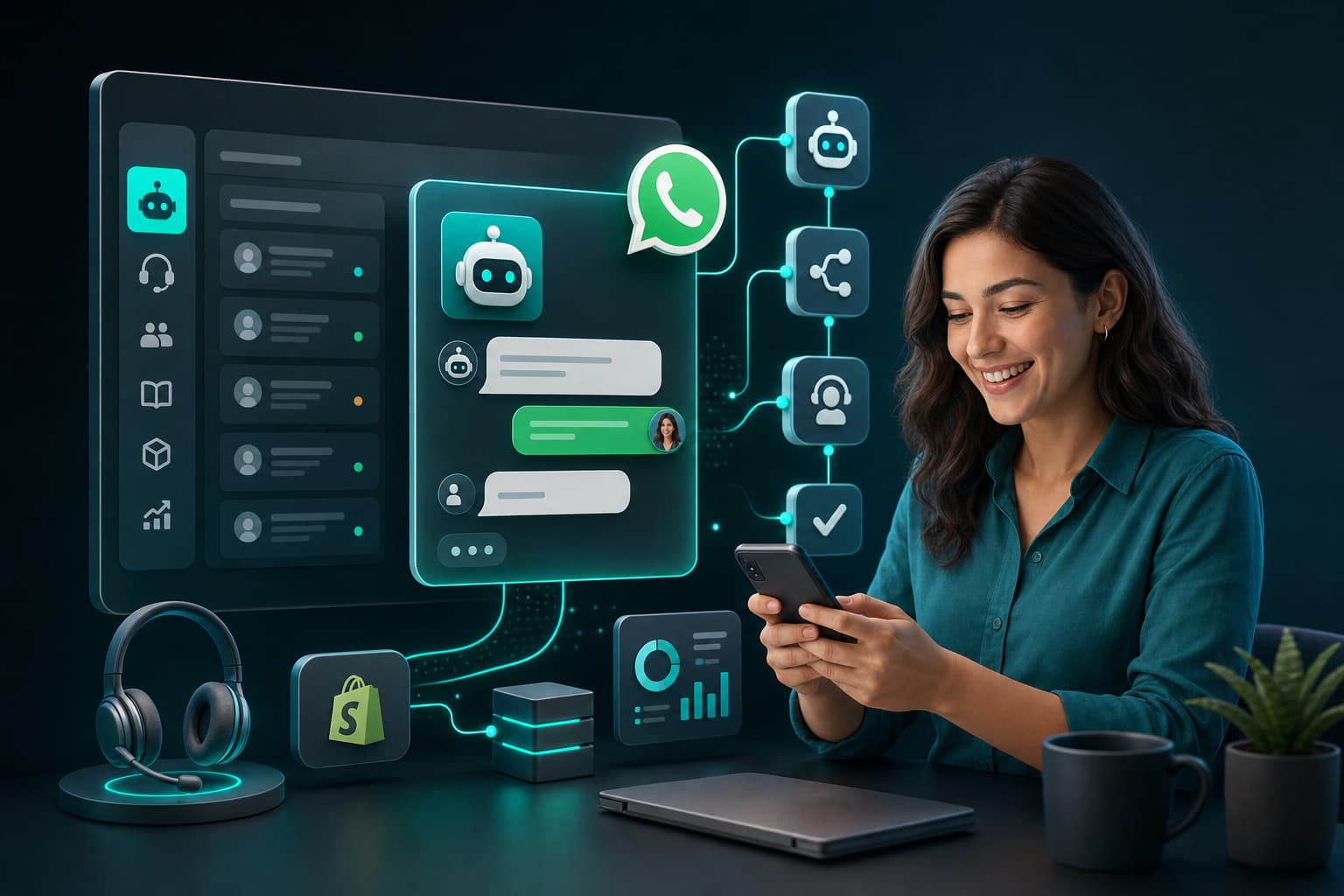
KnowDesk's live agent inbox shows every WhatsApp conversation in one place. When the bot recognizes it can't answer with confidence, it escalates immediately. The live agent sees not just the current message but the entire conversation thread, customer name, previous order history if it's integrated with Shopify, and exactly where the bot left off.
The customer stays in WhatsApp the whole time. They don't get kicked to a web chat or told to "wait for an email response." The experience feels continuous because it is.
This matters for conversion. An online grocery company measured this directly: customers who received instant bot answers to routine questions and fast escalations to humans for complex issues were 31% more likely to complete a follow-up purchase within 14 days compared to customers who got no WhatsApp support at all.
Comparing WhatsApp Chatbot Platforms: What Actually Differs
Not all WhatsApp chatbots are built the same way. Some are general-purpose AI chatbot platforms with WhatsApp as a channel. Others are customer support-specific. The differences matter:
| Feature | KnowDesk | Generic Chatbot Platforms | Legacy Support Ticketing |
|---|---|---|---|
| Setup Time | Under 2 minutes | 2–4 weeks | 4–8 weeks |
| Knowledge Source Integration | Google Docs, Notion, PDF, Confluence, Shopify native | API or manual training | Email-based or web form only |
| No-Code Setup | Yes, fully no-code | Partial; requires API configuration | No |
| Live Agent Inbox | Yes, WhatsApp-native | Often requires separate integration | Legacy, limited mobile support |
| QA Review Capability | Yes, built-in for bot improvement | Rare or as add-on | Not applicable |
| Multi-Language Support | Yes, 80+ languages | Varies; often requires separate deployment | Limited |
| Resolution Rate (Typical First-Contact) | 60–75% for knowledge-base queries | 40–55% depending on training | 5–10% for automated responses |
The key difference: KnowDesk is purpose-built for support teams, not adapted from a general chatbot framework. That design choice surfaces in every feature.
Real Results: What Businesses Measure
Numbers matter. Here's what support teams using KnowDesk report after three months of live deployment on WhatsApp:
- First-contact resolution rate: 62% of WhatsApp conversations end without escalation to a human agent
- Response time: Sub-3-second answers for 91% of queries, compared to average human response time of 45 minutes
- Support team efficiency: Average 38% reduction in repetitive questions routed to live agents, freeing time for complex issues
- Customer satisfaction: Customers who receive instant WhatsApp bot answers report 4.2/5.0 satisfaction, same as human-answered tickets
- Deflection impact: Median 22 minutes of support time saved per customer per month across the customer base
- Scaling: No additional headcount required to handle 3x WhatsApp volume after bot deployment
These numbers come from teams running KnowDesk in production for at least 90 days, across e-commerce, SaaS, and services sectors.
One specific example: a fitness class booking platform deployed KnowDesk's WISMO agent to handle "Where is my booking confirmation?" and "What's the cancellation policy?" questions on WhatsApp. In the first month, 340 conversations that would have reached their support queue were fully resolved by the bot. Their support team processed the same 1,200 monthly tickets with one fewer staff member, while customer wait time dropped from 28 minutes average to 15 minutes for anything requiring human attention.
Building a Smarter Bot Over Time
The best WhatsApp chatbot today should be smarter tomorrow. This happens automatically with KnowDesk if you're intentional about it.
Each conversation the bot has is reviewable through Mission Control, KnowDesk's admin dashboard. You see what questions customers asked, what the bot answered, and whether the customer rated it helpful or not. This data flows directly back: if you notice the bot gives a half-answer to a common question, you update your Notion page with better detail, and within minutes the bot is answering better.
The QA review feature means someone on your team can audit a sample of bot responses weekly (takes 10 minutes) and catch issues before they compound. Did the bot misunderstand a policy edge case? Flag it, fix it, test it, deploy it—all within a few hours instead of waiting for a developer sprint.
This is why bot resolution rate improves over time instead of plateauing. Bad chatbots stay bad. KnowDesk bots get smarter because the cycle of feedback and improvement is built into the platform.
Multi-Language Support: Reaching Global Customers
If your customers span countries, WhatsApp is often the preferred support channel—and they expect answers in their native language.
KnowDesk supports 80+ languages natively. Upload your knowledge base once in English, and the bot automatically detects the customer's language and responds in kind. No need to maintain separate bots or translated document sets. One source of truth, multiple languages.
A London-based fashion brand tested this. Thirty percent of their WhatsApp traffic came from customers in France, Spain, and Germany. After enabling KnowDesk's multi-language support, satisfaction scores among non-English speakers jumped from 3.1/5.0 to 4.3/5.0. The bot's answers were identical in quality—it was the language that mattered.
Brand Control: Your Bot, Your Voice
Generic chatbots talk like robots. They use corporate jargon. They feel impersonal even when they're helping.
KnowDesk's brand gate feature lets you set the tone. You define the voice guidelines for your bot—formal or casual, concise or detailed—and the platform respects those guidelines in every response. Your bot sounds like your brand because it's trained to.
A luxury hotel group uses KnowDesk and trained their bot to sound warm and personalized, mirroring their customer service standard. Guests who interact with the bot on WhatsApp don't feel they're talking to automation—they feel recognized and cared for, even though 61% of their questions are answered entirely by the bot.
Integration That Actually Works: Shopify, Google Docs, Notion, and More
A chatbot is only as good as the data it pulls from. Half-built integrations or manual data entry defeat the purpose of automation.
KnowDesk connects natively to the platforms your team already uses. If you manage products in Shopify, the bot knows your inventory and pricing in real time. If your support docs live in Google Docs or Notion, they become bot knowledge without any conversion step. If you store processes in Confluence, the bot can search and cite them. If you have PDFs, they upload and index in seconds.
This native integration approach is different from most platforms, which offer "Zapier-style" connectors that add latency and complexity. KnowDesk integrates at the API level, meaning data is current and the bot operates on real information.
See pricing and feature tiers to match KnowDesk's integration depth to your setup, or start exploring how this works with a free trial.
How to Choose a WhatsApp Chatbot: The Right Questions to Ask
When evaluating platforms, ask these questions and see which ones the vendor struggles to answer clearly:
- Can I set this up without a developer? Can you show me a demo of the no-code workflow? (Most can't.)
- How long does deployment actually take in practice? Is that the time to "create an account" or time to "answering real customer questions"? (These are very different things.)
- Where does the bot pull knowledge from? Can it read my existing Notion pages or Google Docs, or do I have to copy-paste content into your system? (Copy-paste means your docs go out of sync.)
- What happens when the bot is uncertain? Can it escalate gracefully to a human while keeping the conversation in WhatsApp? (This is how you prevent bot frustration.)
- How do I improve the bot over time? Is there a feedback loop and QA system, or am I stuck with whatever accuracy it launches with? (Static bots degrade.)
- Can I see what the bot is being asked? Do I get visibility into what it's failing to answer? (This is how you spot gaps.)
KnowDesk clears every one of these hurdles. Most competitors fail on at least three.
Implementation: From First Question to First Sale
Here's what the first week of a KnowDesk WhatsApp deployment looks like:
Day 1: Sign up and connect your knowledge source (Google Docs, Notion, PDF, Confluence, or Shopify). The bot is live within two minutes.
Days 2–3: Customers start asking questions. The bot answers the ones in your knowledge base. Anything it's unsure about routes to your team. You see all conversations in the live agent inbox.
Days 4–5: Your team reviews bot responses through Mission Control. You spot a pattern: customers ask about return shipping costs, but your Notion page doesn't spell it out clearly. You update Notion. The bot is smarter by lunch.
Week 2+: Resolution rate climbs as the bot learns. Your support queue drops. Customers who get instant bot answers come back. Metrics improve.
That's real deployment. No months of setup. No developer hiring. No project delays.
Cost Comparison: Why Speed Matters Financially
A generic chatbot platform might charge $500/month but take three months to deploy. That's $1,500 sunk before you help a single customer.
KnowDesk's pricing is transparent. Check KnowDesk pricing for exact tiers, but the model is usage-based and started pricing. You pay for conversations you actually have, not for months of setup and configuration. A small business might start at $50/month and scale to $200/month as WhatsApp volume grows. A larger operation runs their bot for under $800/month even at scale.
More importantly: you start getting ROI in week one, not month four. If your bot handles 50 support conversations in the first week (saving 50 human-handled tickets), that's quantifiable value immediately.
Starting Your WhatsApp Chatbot: The Next Step
You now have enough information to make a decision. A great WhatsApp chatbot comes down to three non-negotiable features: it has to pull knowledge from documents your team actually maintains, it has to deploy in minutes not weeks, and it has to hand off to a human gracefully when needed.
KnowDesk does all three. Its no-code setup, native integrations with Google Docs, Notion, Confluence, PDF, and Shopify, and purpose-built support workflow mean you go from "no WhatsApp bot" to "deflecting support traffic" in an afternoon. Your team gets immediate relief. Your customers get instant answers. Your metrics improve measurably.
Start a free trial today. Deploy a bot to WhatsApp in two minutes. Answer your first customer questions before the day ends. You'll know within 48 hours whether this is the right fit for your support operation. No credit card. No long-term commitment. No setup call required.