AI Chatbot for Ecommerce: 2026 Guide
Discover how AI chatbots transform ecommerce customer support. Reduce costs, boost sales, and improve customer satisfaction with intelligent automation.


Quick answer
AI chatbots are revolutionizing ecommerce by automating customer support 24/7. Learn how to implement conversational AI to increase conversions and reduce support costs.
On this page
- What Is an AI Chatbot for Ecommerce and How Does It Work?
- Key Benefits of AI Chatbots for Online Retailers
- Common Ecommerce Customer Support Challenges That AI Chatbots Solve
- How to Deploy an AI Chatbot on Your Ecommerce Website in Minutes
- Real-World Ecommerce Use Cases for AI Chatbots
- AI Chatbot Features That Matter for Ecommerce Success
- Measuring AI Chatbot Success Metrics and ROI
- Getting Started With Your Ecommerce AI Chatbot Today
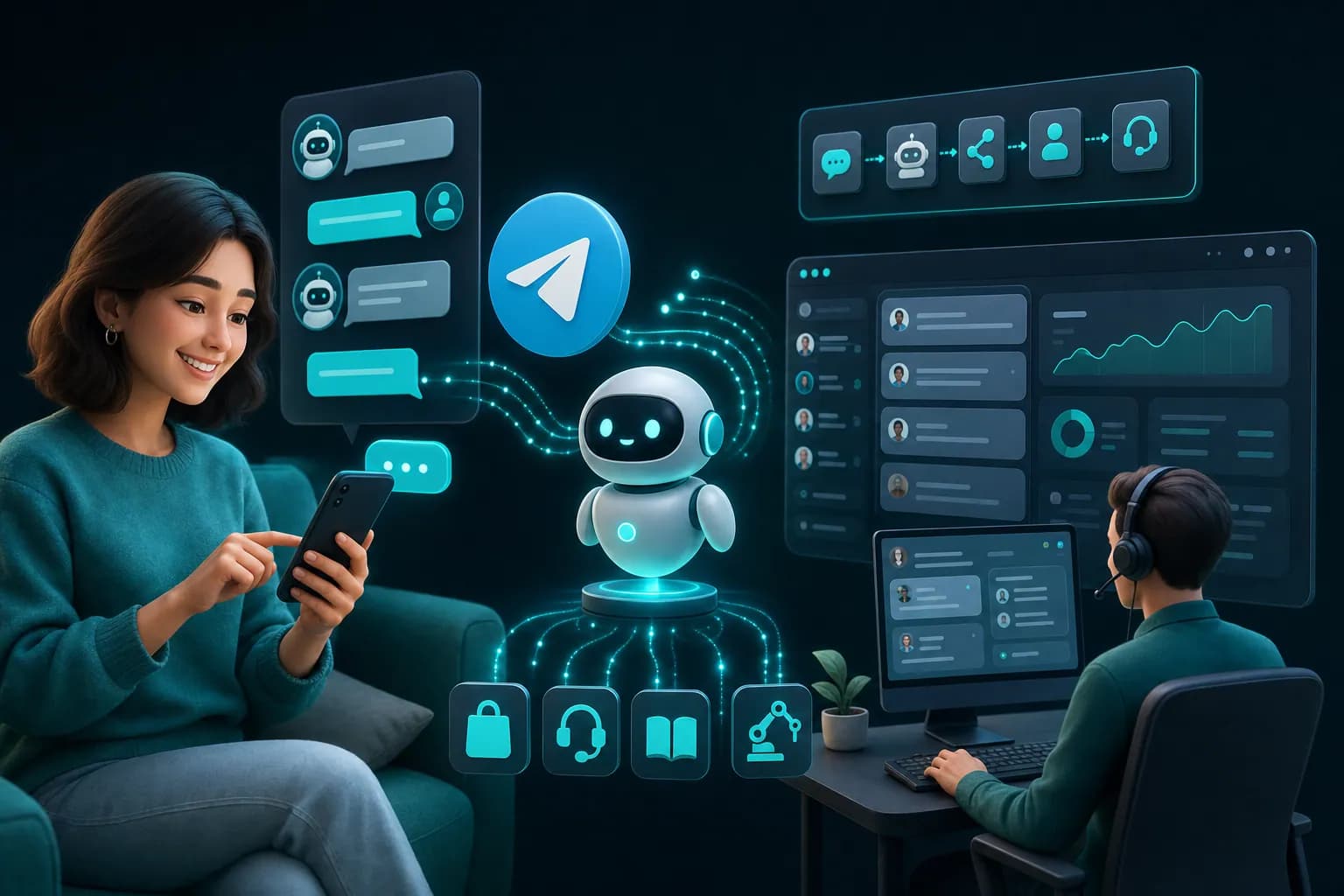
An AI chatbot for ecommerce automates customer support by answering product questions, processing orders, and resolving issues instantly. These intelligent assistants handle inquiries 24/7 without human intervention. They reduce support costs while improving customer satisfaction. Modern ecommerce chatbots integrate seamlessly with your website, email, and product databases. Powered by AI, they learn from your business data to deliver accurate, brand-consistent responses instantly.
What Is an AI Chatbot for Ecommerce and How Does It Work?
An AI chatbot for ecommerce is a conversational software system designed specifically for online retail environments. It uses natural language processing and machine learning to understand customer questions. The chatbot then provides relevant, helpful responses based on your business information.
These chatbots operate by ingesting your knowledge sources—product catalogs, FAQs, Notion pages, Google Docs, PDFs, and Confluence documentation. The AI learns the content structure and context. When a customer asks a question, the chatbot searches your knowledge base in real time. It retrieves the most relevant information and formulates a response that matches your brand voice.
In 2026, ecommerce chatbots are more sophisticated than ever. They handle complex queries involving shipping policies, returns, sizing guides, and product comparisons. Many integrate directly with your order management system. This allows them to provide real-time order status updates without human involvement. The result is faster response times and happier customers.
Key Benefits of AI Chatbots for Online Retailers
Implementing an AI chatbot in your ecommerce business delivers measurable, immediate benefits. The financial impact alone justifies the investment. However, the advantages extend far beyond cost savings alone.
First, chatbots dramatically reduce your support team's workload. Your staff handles only complex issues that require human judgment. This frees up your team to focus on high-value tasks like customer retention and upselling. In addition, employees experience less burnout from repetitive questions. Job satisfaction typically increases when teams work with intelligent automation.
Second, AI chatbots operate 24/7 without breaks or fatigue. Your ecommerce store never closes, and neither does your support. Customers receive instant answers at 2 AM on Sunday just as quickly as 2 PM on Monday. This round-the-clock availability significantly improves customer experience. It also increases conversion rates by eliminating friction during the buying journey.
Third, chatbots provide consistent, accurate information every single time. Unlike human agents, they never misunderstand product specs or policies. Every response pulls directly from your verified knowledge sources. This eliminates the risk of giving customers incorrect information. Your brand reputation stays protected.
- Reduce support ticket volume by up to 80% through automated first-response handling
- Decrease average response time from hours to seconds with instant AI replies
- Lower customer support costs while maintaining or improving service quality
- Increase customer satisfaction scores through faster issue resolution
- Enable 24/7 support without hiring night-shift staff or outsourcing teams
- Collect valuable customer data and insights from chatbot conversations
- Reduce cart abandonment by answering product questions in real time during checkout
Common Ecommerce Customer Support Challenges That AI Chatbots Solve
Every ecommerce business faces recurring support challenges. These pain points drain resources and frustrate customers. Fortunately, AI chatbots address each one effectively.
High Volume of Repetitive Questions — Customers constantly ask about shipping times, return policies, product availability, and sizing. Your team answers these same questions hundreds of times monthly. This wastes valuable time and resources. An AI chatbot handles these repetitive inquiries instantly. Your team never wastes time on "what's your shipping policy?" again.
Inconsistent Response Quality — Different support agents respond differently to similar questions. One person might be helpful and thorough. Another might be curt or incomplete. Customers notice these inconsistencies. They damage your brand reputation. Chatbots deliver identical, high-quality responses every time. Every customer receives the same level of service regardless of when they contact you.
Extended Response Times During Peak Hours — Holiday seasons, flash sales, and product launches overwhelm your support team. Customers wait hours or days for responses. Many abandon their carts in frustration. An AI chatbot scales instantly without hiring temporary staff. Thousands of customers receive immediate responses simultaneously.
Poor Availability Outside Business Hours — When your team clocks out, support stops. Customers in different time zones or working night shifts can't get help. They email complaints or leave negative reviews. With an AI chatbot, support never stops. Customers get instant answers whenever they need them.
High Support Costs — Each support agent represents salary, benefits, training, and infrastructure costs. As your business grows, support costs grow proportionally. This squeezes profit margins. Chatbots have a fixed cost that doesn't increase with support volume. They handle 10 questions or 10,000 with the same efficiency.
How to Deploy an AI Chatbot on Your Ecommerce Website in Minutes
In 2026, deploying a chatbot should be fast and simple. Outdated solutions require weeks of development and thousands in consulting fees. Modern platforms eliminate this friction entirely. With KnowDesk, you can start a free trial and have a chatbot running in minutes, not months.
The deployment process is straightforward. First, gather your knowledge sources. This includes product descriptions, FAQs, shipping policies, return procedures, and any other customer-facing documentation. These can exist in Google Docs, Notion pages, PDF files, or Confluence. KnowDesk accepts all these formats without conversion or reformatting.
Second, connect your knowledge sources to the KnowDesk platform. This is a simple, no-code process. You simply authenticate your documents and authorize access. The AI system immediately begins analyzing and indexing your content. No technical skills required.
Third, customize the chatbot's appearance to match your brand. Configure colors, logos, welcome messages, and tone of voice. The embedded widget should feel native to your website. Customers shouldn't sense they're talking to an AI—they should feel like they're engaging with your brand.
Fourth, embed the chatbot on your website using a simple code snippet. This takes one minute. No complex integrations or dependencies. If you run a Shopify store, the Shopify app makes deployment even easier. The chatbot appears on your site immediately and starts handling customer inquiries right away.
- Select your knowledge sources from Google Docs, Notion, PDF, or Confluence
- Authenticate and connect your documents in the KnowDesk dashboard
- Customize the chatbot widget to match your brand colors and voice
- Generate the embed code and paste it into your website HTML
- Launch the chatbot and begin answering customer questions automatically
- Monitor conversations and refine responses based on customer interactions
- Scale the chatbot as your business grows without additional investment
Real-World Ecommerce Use Cases for AI Chatbots
AI chatbots excel across dozens of ecommerce scenarios. Understanding specific use cases helps you visualize the impact on your business.
Product Recommendation and Comparison — Customers often need help choosing between products. They ask "What's the difference between your premium and standard packages?" or "Which size should I order?" Rather than scrolling through pages, they ask the chatbot. The AI retrieves product specifications and guides them toward the best choice. This reduces returns caused by poor selections and increases customer satisfaction.
Order Status Tracking — Customers obsessively check order status, especially for time-sensitive purchases. Rather than logging into your system, they ask the chatbot "Where's my order?" The AI connects to your fulfillment system and provides instant tracking information. Your support team handles zero tracking questions.
Return and Refund Processing — Return policies confuse many customers. They ask "What's your return window?" "Do I get free returns?" "How do I initiate a return?" The chatbot answers all these questions instantly and can guide customers through the entire return process. Your team only handles edge cases or disputes.
Sizing and Fit Guidance — Apparel and shoe retailers struggle with fit-related returns. Customers ask "What's the sizing chart?" "Does this run large or small?" "What's the material?" The chatbot provides detailed sizing information, material composition, and care instructions. Fewer wrong-size orders means fewer returns and happier customers.
Shipping and Delivery Information — Every customer wants to know shipping costs, delivery times, and available methods. Instead of hunting your website, they ask the chatbot once. The AI provides instant information about standard, expedited, and international shipping options.
Promotional and Discount Communication — When you launch a sale or promotion, your chatbot becomes a powerful communication tool. It explains discount terms, highlights featured products, and answers questions about eligibility. This drives conversion during critical sales periods.
AI Chatbot Features That Matter for Ecommerce Success
Not all ecommerce chatbots are created equal. Certain features directly impact your success rate and customer satisfaction.
| Feature | Why It Matters for Ecommerce | Impact on Your Business |
|---|---|---|
| Multi-source Knowledge Integration | Connects to Google Docs, Notion, PDFs, Confluence simultaneously | Single source of truth for all customer information |
| Real-time Order Status Access | Integrates with fulfillment and ecommerce platforms | Eliminates 40-60% of status-check support tickets |
| Brand Voice Customization | Matches your unique communication style and tone | Customers feel they're talking to your brand, not a generic bot |
| 24/7 Availability | Never closes, operates across all time zones | Captures sales and support at peak customer demand times |
| Fallback to Human Agents | Escalates complex issues to your team seamlessly | No customers get stuck; complex issues handled with context |
| Analytics and Insights | Tracks conversations, identifies common questions, measures performance | Data-driven improvements to your knowledge base and processes |
| No-Code Setup | Deploys in minutes without technical expertise | Immediate ROI without development costs or delays |
Therefore, prioritize features that directly solve your specific pain points. For a fashion retailer, sizing guidance matters most. For electronics, technical specifications and comparison capabilities take priority. For subscription services, billing questions dominate. Evaluate chatbots based on which features address your most common support issues.
Measuring AI Chatbot Success Metrics and ROI
To justify your chatbot investment, you need clear metrics. In 2026, chatbot success should be measured quantitatively and qualitatively.
Cost Reduction Metrics — Track the percentage of support tickets handled entirely by the chatbot. Most successful implementations handle 40-80% of incoming tickets without human intervention. Calculate the cost savings by multiplying this percentage by your average support cost per ticket. Most ecommerce businesses recover their chatbot investment within 3-6 months through labor savings alone.
Response Time Improvements — Measure average response time before and after chatbot deployment. Previously, if your team took 4 hours to respond, the chatbot delivers answers in 3 seconds. Faster response times correlate directly with higher customer satisfaction and conversion rates. Track this metric weekly to monitor performance.
Customer Satisfaction Scores — Implement post-chat surveys asking customers about their experience. Did the chatbot solve their problem? Would they recommend your support to a friend? Satisfied customers via chatbot are just as likely to make repeat purchases as those helped by humans. Your CSAT score should remain stable or improve after deployment.
Conversion Rate Impact — Monitor how chatbot implementation affects your overall conversion rate. By answering product questions during the shopping journey, chatbots reduce cart abandonment. Many retailers see conversion rate improvements of 5-15% within the first month.
Ticket Deflection Rate — Calculate what percentage of tickets were resolved by the chatbot without escalation. Higher deflection rates indicate better chatbot performance and less pressure on your team. Aim for at least 50% deflection initially, increasing to 70%+ with optimization.
In addition, track customer sentiment in chatbot conversations over time. Are customers expressing satisfaction or frustration? Use this feedback to continuously improve your knowledge base. When customers ask questions the chatbot can't answer, update your documentation. This creates a virtuous cycle of improvement.
Getting Started With Your Ecommerce AI Chatbot Today
The time to implement an AI chatbot is now. In 2026, delaying this decision puts your ecommerce business at a competitive disadvantage. Customers expect instant support. They expect it 24/7. They expect it to be accurate. Your competitors are already delivering this experience.
The good news? Getting started is simpler than you think. You don't need weeks of planning or massive budgets. With KnowDesk, you can deploy a fully functional chatbot on your ecommerce site in minutes. Simply start a free trial and experience the transformation firsthand.
During your free trial, connect your existing knowledge sources—product documentation, FAQs, policies, anything you've already created. The AI immediately learns your business and starts answering customer questions. No training required. No configuration needed beyond basic branding customization.
After your trial, explore KnowDesk pricing options that fit your business size and support volume. Whether you handle 100 chats monthly or 100,000, there's a plan designed for you. View see pricing details to understand the investment required. Most businesses discover that the ROI is immediate and substantial.
For detailed information on features, integration capabilities, and best practices, consult the documentation. The knowledge base contains setup guides, troubleshooting articles, and optimization strategies. If you operate on Shopify, the Shopify app offers native integration without any code or technical configuration.
Therefore, the path forward is clear. Your ecommerce business needs an AI chatbot to remain competitive in 2026. Customers demand instant, accurate support across time zones and hours. They expect your brand to meet their needs immediately. An AI chatbot transforms your customer support from a cost center into a competitive advantage.
Today is the perfect day to implement an AI chatbot for your ecommerce business. Don't wait for your competitors to capture more market share through superior customer experience. Start a free trial now and join hundreds of ecommerce retailers delivering world-class support instantly. Your customers—and your bottom line—will thank you.