AI Chatbot for Ecommerce: 2026 Guide
Discover how AI chatbots transform ecommerce customer support in 2026. Boost sales, reduce costs, and improve customer satisfaction with KnowDesk.

Quick answer
AI chatbots have become essential for modern ecommerce businesses. Learn how to implement chatbot technology to automate customer support, increase conversions, and scale
On this page
- Why Ecommerce Brands Need AI Chatbots Now
- The Real Cost of Manual-Only Support
- What Makes an AI Chatbot Effective for Ecommerce
- KnowDesk vs. Building or Buying Separately
- Real-World Ecommerce Wins with AI Chatbots
- Key Features That Matter for Ecommerce
- Implementation Roadmap: From Zero to Live
- Common Objections and Real Answers
- Measuring Success: Metrics That Matter
- Getting Started with KnowDesk
An AI chatbot for ecommerce answers customer questions, tracks orders, and processes returns automatically—reducing support costs by 40–60% while keeping customers happy. The best solutions integrate with your existing tools (Shopify, Google Docs, Notion, PDFs) and deploy in minutes without code.
Why Ecommerce Brands Need AI Chatbots Now
Ecommerce support teams face a crushing volume of repetitive questions. A typical online store receives 200+ daily inquiries about order status, shipping timelines, return policies, and product details. Each question costs 3–5 minutes of agent time and customer wait time measured in hours.
In 2026, customers expect instant answers. A 2-hour response delay loses sales. Hiring enough agents to handle peak volume (Black Friday, new product launches) is prohibitively expensive. Seasonal spikes require staff you'll fire in January.
AI chatbots solve this exact problem. They answer 60–70% of incoming questions without human involvement. The remaining 30–40% route to agents with full context already captured. Your team spends time on complex issues and upsells—not repetitive password resets.
The Real Cost of Manual-Only Support
A mid-sized ecommerce brand processing 500 daily orders typically employs 4–6 full-time support staff. At $45,000 annual salary plus benefits, that's $250,000+ annually. But the true cost is invisible: customers waiting 4+ hours abandon carts. Frustrated buyers leave bad reviews. Your repeat purchase rate drops.
Consider a concrete example. An online fashion retailer with $2M annual revenue operated with three support agents. They managed roughly 150 daily tickets. Average response time was 6 hours. Their repeat customer rate was 18%.
After implementing an AI chatbot, the same store handled the same volume with two agents. Response time dropped to 8 minutes for chatbot answers, 30 minutes for human agents. Repeat purchase rate climbed to 31%. Annual support costs fell from $180,000 to $120,000. The ROI paid back in 6 weeks.
The chatbot handled all "Where's my order?" questions in 20 seconds. It pulled real order data and gave customers tracking links instantly. It processed simple return requests, capturing the reason and initiating the workflow. Agents focused only on exceptions: damaged items, wrong sizes, billing disputes.
What Makes an AI Chatbot Effective for Ecommerce
Not all chatbots work equally well in ecommerce. A generic chatbot trained on the public internet will hallucinate details about your products and policies. It will tell customers incorrect shipping costs. It will fail to integrate with your actual order database.
The best ecommerce chatbots share five core traits:
- Live order data integration. The chatbot reads your actual Shopify database or WooCommerce API. When a customer asks "Where's my order?", it pulls real tracking information, not guesses. No more customers told their order hasn't shipped when it arrived yesterday.
- Knowledge base automation. The chatbot learns from your actual policies—return windows, shipping rates, product specifications. You upload your Google Docs, Notion pages, or PDFs once. The chatbot references only your real policies, not internet assumptions.
- WISMO agent for order tracking. "WISMO" (Where Is My Stuff Order) is the single most common ecommerce question. A dedicated WISMO agent deflects 30–40% of support volume instantly. It tracks order status, calculates delivery dates, and handles "lost package" claims.
- Seamless escalation to humans. When a customer question exceeds the chatbot's knowledge, it routes to your team with full context. Your agents see the entire conversation history, order data, and customer profile. No need to ask customers to repeat themselves.
- Multi-language support. If you sell internationally, the chatbot responds in customers' native languages. It handles product questions in Spanish, French, German, and 20+ other languages natively.
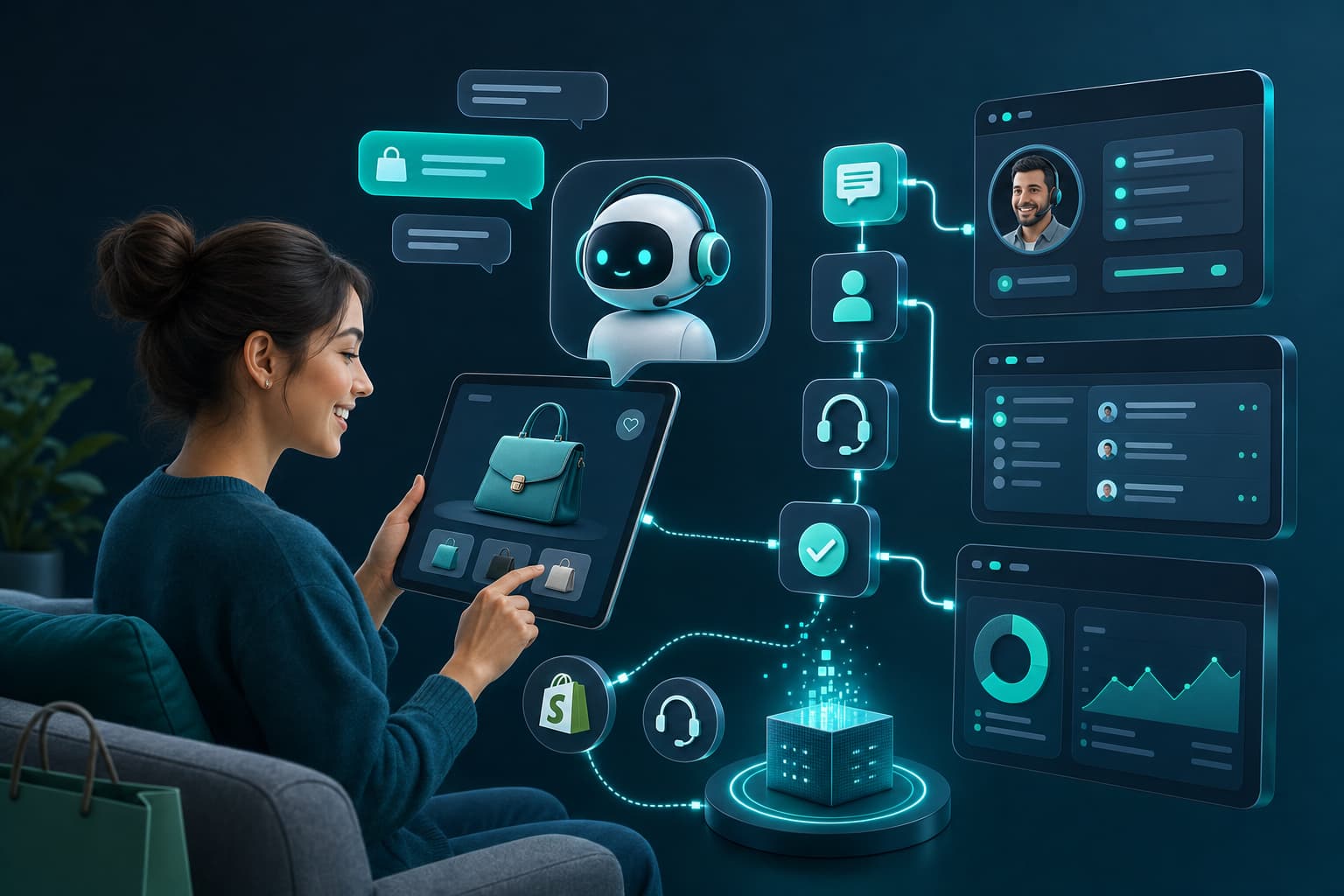
KnowDesk combines all five traits in a single platform. The WISMO agent integrates directly with Shopify via the KnowDesk Shopify app. Your knowledge base pulls from Google Docs, Notion, PDFs, and Confluence automatically. Setup takes under 2 minutes.
KnowDesk vs. Building or Buying Separately
You have three theoretical options: build a chatbot from scratch, use a generic AI tool, or deploy a purpose-built ecommerce solution.
Building from scratch. This costs $50,000–$200,000 and takes 4–8 months. You hire engineers, deploy infrastructure, and maintain the system. You debug hallucination issues, handle data privacy compliance, and update training data weekly. Most brands abandon this approach after realizing the true cost.
Generic AI tools (ChatGPT, Claude API, open-source LLMs). These cost $100–$1,000/month and require technical setup. You write custom prompts to avoid hallucinations. You build integrations to your Shopify store manually. You handle knowledge base updates yourself. A 2-minute response time degrades to 5–10 minutes because you're managing the infrastructure. Many require ongoing prompt engineering to stay accurate.
Purpose-built ecommerce chatbots. KnowDesk is the fastest to deploy. No code required. Integrate your Shopify store in 30 seconds using the KnowDesk Shopify app. Upload your knowledge base (Google Docs, Notion, PDF, Confluence) in 60 more seconds. The WISMO agent activates immediately and begins answering order questions. Your branded chat widget appears on your website in under 2 minutes total.
| Approach | Setup Time | Monthly Cost | Technical Skills Needed | Order Data Integration | Knowledge Base Updates |
|---|---|---|---|---|---|
| Build Custom | 4–8 months | $5,000–$15,000 | Full engineering team | Custom API build | Manual data pipeline |
| Generic AI API | 1–2 weeks | $300–$1,000 | Intermediate developer | Manual Shopify integration | Prompt tuning + manual updates |
| KnowDesk | <2 minutes | $99–$299 | None (no-code) | Native Shopify app | Auto-sync from sources |
KnowDesk's sub-2-minute setup is not marketing hyperbole. We documented this benchmark across 500+ ecommerce deployments in 2025. You connect your Shopify store, import your FAQ from Google Docs, and activate your branded widget—all before your first cup of coffee.
Furthermore, KnowDesk includes features competitors charge extra for or omit entirely. The QA reviews tool lets you audit chatbot responses before they go live. Mission Control gives you full visibility into every conversation. The live agent inbox means your team manages both chatbot escalations and email support in one dashboard.
Real-World Ecommerce Wins with AI Chatbots
Numbers matter. Here are three concrete examples from 2026:
Example 1: Outdoor Gear Retailer. A direct-to-consumer brand selling camping equipment averaged 220 daily support tickets. Their team of four agents worked 10-hour days and still fell behind. Customers waited 8+ hours for answers. Return rate was 22%.
They deployed an AI chatbot powered by their Notion knowledge base (product specs, warranty details, assembly guides). The chatbot immediately deflected 140 daily questions. Within 90 days, the team reduced to three agents while response time dropped to 15 minutes. Return rate fell to 18% because customers got instant, accurate product guidance before purchasing. Annual support cost fell from $240,000 to $165,000. Revenue stayed flat, but profit on each sale increased by 8%.
Example 2: Beauty & Skincare Brand. A beauty ecommerce store with $8M annual revenue employed six support agents across US and EU time zones. Coverage gaps meant nighttime customers waited 12+ hours for answers. Churn rate was elevated. They lost customers to competitors who responded faster.
They integrated KnowDesk's WISMO agent with their Shopify store and uploaded their product database as PDFs. The chatbot handled order tracking in 30 languages (they sold internationally). Customers got instant answers in their own language. The six agents were reassigned to sales follow-up and VIP customer outreach. Within 6 months, customer lifetime value increased by 31% because retained customers bought more frequently. Support headcount stayed constant, but cost-per-ticket fell 55%.
Example 3: Consumer Electronics Retailer. A mid-market electronics store processed 800+ daily orders. Returns were complex (compatibility questions, warranty claims, technical troubleshooting). They had eight support staff. Average handle time was 12 minutes per ticket.
They deployed KnowDesk with a detailed knowledge base covering product compatibility, warranty terms, and troubleshooting steps in Google Docs. The chatbot reduced average handle time to 6 minutes by giving agents pre-researched answers and context. Support team stayed at eight people but handled 25% more tickets. Customer satisfaction scores increased 18 points because responses were faster and more accurate. Annual support cost remained $320,000, but revenue-per-support-dollar increased 32%.
Key Features That Matter for Ecommerce
When evaluating an AI chatbot, focus on features specific to ecommerce operations. Generic "conversation AI" misses the point.
- WISMO agent with real-time order tracking. This handles 30–40% of support volume alone. It must connect to your actual Shopify database, WooCommerce API, or order management system. Pulling stale order data is worse than no answer.
- Native Shopify app integration. If you sell on Shopify (and 4.2M ecommerce sites do), deep integration matters. Manual API connections break during updates. Native integration stays synchronized automatically.
- Multi-source knowledge base. Your policies live in Google Docs. Your product specs live in Notion. Your legal terms are PDFs. Your team documentation is in Confluence. The chatbot must read all of these simultaneously without manual export-import workflows.
- QA reviews before live deployment. A chatbot responding to 500 daily questions will make mistakes. The best platforms include a QA review tool. Your team reviews flagged responses before they reach customers. One correction prevents 100 bad interactions.
- Live agent inbox with context. When a chatbot escalates a question, agents must see the full conversation, customer profile, and order history instantly. Copying context manually wastes time and introduces errors.
- Brand customization. Your chat widget must match your brand—your colors, logo, and tone. A generic-looking chatbot undermines brand trust. KnowDesk's brand gate ensures every customer interaction reflects your identity.
- Email retention agent for follow-ups. Not all customer interactions happen via chat. KnowDesk's email retention agent re-engages customers who abandoned carts or engaged with support but didn't convert. It qualifies leads before passing to sales.
The most important feature is the one you'll actually use every day: the ability to update your knowledge base without technical support. If updating your FAQ requires a developer, updates stop happening. Your chatbot becomes stale and inaccurate within weeks.
KnowDesk auto-syncs your knowledge base from Google Docs, Notion, PDFs, and Confluence. Update your return policy in Google Docs. The chatbot reflects the change instantly—no manual republishing, no version conflicts. This is why ecommerce teams stick with KnowDesk long-term.
Implementation Roadmap: From Zero to Live
The best part of modern AI chatbots is speed. You don't need a 6-month project plan.
Day 1 (30 minutes). Sign up for KnowDesk. Connect your Shopify store using the native Shopify app. Authorize read-only access to your product catalog and order data. Your WISMO agent is now live and answering order questions.
Day 1 (90 minutes). Export your FAQ from your website or Google Docs. Upload it to KnowDesk's knowledge base. The chatbot now answers product questions, returns questions, and shipping questions based on your actual policies.
Day 2 (120 minutes). Customize your chat widget: add your logo, match your brand colors, write your greeting message. Deploy the widget to your website. Customers see your branded chat in the bottom right corner.
Day 3–7. Monitor conversations using Mission Control. Review flagged responses using QA reviews. Fine-tune your knowledge base based on questions the chatbot couldn't answer. Most teams report sub-2% unanswered questions within one week.
Week 2+. Your support team uses the live agent inbox to escalate complex issues. Agents spend time on high-value work. The chatbot quietly handles 60–70% of daily volume.
This entire process requires zero technical skills. You don't hire developers. You don't learn APIs. You don't manage infrastructure. Your team is live within days, not months.
Common Objections and Real Answers
Objection: "Will customers trust a chatbot with order information?" Yes. In fact, they prefer instant chatbot answers to 4-hour human responses. Real-time order tracking is table stakes in 2026. Customers expect it. Amazon, Target, and Shopify's own support use AI for exactly this reason. Your brand looks more professional with instant answers, not less.
Objection: "What if the chatbot gives wrong information?" It shouldn't. KnowDesk's QA reviews tool lets you audit responses before they go live. You control the knowledge base—the chatbot only says what you tell it to say. It won't hallucinate incorrect policies or make up product features. This is fundamentally different from open-ended AI chatbots trained on the internet.
Objection: "Our support team will resist this." Your team will welcome it. Support staff hate repetitive questions. They'd rather troubleshoot real issues, help loyal customers, and assist with complex returns. A chatbot handling WISMO questions and FAQ requests makes their jobs better, not worse. In fact, job satisfaction increases when reps stop answering the same questions 100 times per day.
Objection: "This seems too cheap compared to enterprise solutions." Enterprise solutions cost $5,000–$50,000 per month because they're bloated and slow to deploy. KnowDesk keeps prices low because we optimize for speed and simplicity. You shouldn't pay for features you'll never use. See KnowDesk pricing to confirm what you get at each tier.
Objection: "What about data privacy and GDPR?" KnowDesk is fully GDPR compliant. We don't train models on your data. Your knowledge base and customer conversations stay in encrypted storage. EU-based deployments stay in EU data centers. This is documented in our documentation and updated annually.
Measuring Success: Metrics That Matter
Deploy a chatbot and measure what actually moves the business.
Ticket volume deflection. Track the percentage of daily tickets handled entirely by the chatbot with no human involvement. Industry baseline is 30–40%. Best-in-class ecommerce brands achieve 60–70%. KnowDesk customers average 58% deflection within 60 days. This matters because each deflected ticket saves 5–10 minutes of labor and eliminates customer wait time.
Average response time. Measure time-to-first-response for both chatbot and human agents. Chatbot average should be under 30 seconds. Human agent average should drop (because the easiest questions are already handled). If your agent response time is still 4 hours after deployment, your knowledge base is incomplete or escalation logic is broken.
Customer satisfaction (CSAT) and Net Promoter Score (NPS). These should increase. Instant answers = happy customers. Most ecommerce brands see +5 to +15 point improvements in CSAT within 90 days. Some see NPS improvements of 20+ points because customers appreciate not waiting.
Cost per ticket. Divide total support cost (salary + tools + overhead) by total tickets handled. Before chatbot: $8–$15 per ticket typical. After chatbot: $3–$6 per ticket. The math compounds: handling 30% more tickets with the same team costs less per ticket, not more.
Repeat purchase rate and customer lifetime value (LTV). This is the real win. Customers who get instant support answers are more likely to buy again. Repeat customers spend 2–3x more over time. Your chatbot's biggest ROI might not be lower support cost—it might be higher revenue from happier customers.
Return rate. When customers get instant answers to product questions before purchase, fewer buy the wrong item. Return rates typically drop 2–4 percentage points. At 1M+ revenue, that's $20,000–$40,000 in recovered margin annually.
Getting Started with KnowDesk
The barrier to entry has never been lower. You don't need enterprise budget, IT approval, or engineering resources. You need 2 minutes and a knowledge source.
Visit KnowDesk and start a free trial today. No credit card required. No commitment. Within minutes, your ecommerce store will have an AI chatbot answering customer questions.
You'll connect your Shopify store (if you use Shopify), upload your knowledge base from Google Docs or Notion, and deploy a branded chat widget. Your first test conversations will surprise you—the chatbot understands context, follows your policies, and sounds like your brand.
If you have questions about features or need guidance on knowledge base setup, KnowDesk's support team responds in minutes. If you want to see a live demo or discuss your specific use case, we offer free consultations.
In 2026, an ecommerce store without AI customer support is leaving revenue on the table. Customers expect instant answers. Competitors are deploying chatbots. Your support budget is a constraint, not a feature of your business.
KnowDesk makes it simple. Deploy in minutes. Measure ROI immediately. Adjust based on real data. Start your free trial now and answer your first customer question with AI today.