Best Intercom Alternatives for Small Business 2026
Compare top Intercom alternatives for small business. Find affordable, scalable AI customer support software that cuts costs without sacrificing quality.
Quick answer
Looking beyond Intercom? Discover cost-effective alternatives designed for small business growth in 2026. Compare features, pricing, and real customer support capabilities.
On this page
- Why Small Businesses Outgrow Intercom Fast
- The Real Cost of Intercom for Small Businesses
- KnowDesk's Sub-2-Minute Setup vs. Intercom's Day-Long Onboarding
- Knowledge Base Integration: KnowDesk Wins Decisively
- The WISMO Agent: AI Support That Actually Works
- Brand Control and Custom Domains (Intercom Charges Extra; KnowDesk Includes It)
- Live Agent Inbox and Mission Control
- Shopify Integration: Native vs. Workaround
- Getting Started with KnowDesk: Why Small Businesses Choose It
- Why KnowDesk Wins for Small Businesses in 2026
Small businesses need customer support software that doesn't require a technical team, doesn't break the budget, and works out of the box. Intercom is the industry default, but it charges $500–$1,400 per month and demands significant setup work. KnowDesk replaces Intercom for small businesses—deploying in under 2 minutes with no code, integrating your existing knowledge base, docs, or PDFs directly, and costing 70–80% less. This comparison shows why small business owners are switching.
Why Small Businesses Outgrow Intercom Fast
Intercom built its reputation on beautifully designed chat widgets. The problem: that design comes with a price tag and complexity that punishes small teams. A small e-commerce brand or SaaS startup gets hit with setup fees, onboarding charges, and then monthly fees that scale with your volume.
The real friction isn't the cost alone—it's the setup tax. Intercom requires you to connect your systems (Shopify, Help Scout, Zendesk, etc.), design your workflows, write message rules, and train your team on a platform built for enterprise support teams. A single person wearing the support hat doesn't need 40 features; they need something that answers customer questions immediately and gets out of the way.
Intercom's Messenger sits passively on your site. Customers type, and Intercom pings your team in an inbox. Works fine if your team is online. Breaks down when you're a 2–3 person operation and need an AI that actually solves problems before your team even sees the ticket.
The Real Cost of Intercom for Small Businesses
Intercom's pricing model is deceptive. The "$39/month" plan you see online is a bait—it covers only one team member and includes no Messenger widget customization, no conversation history beyond 3 months, and no automation. Once you add conversation tracking, unlimited team members, and basic automation, you're paying $499/month minimum.
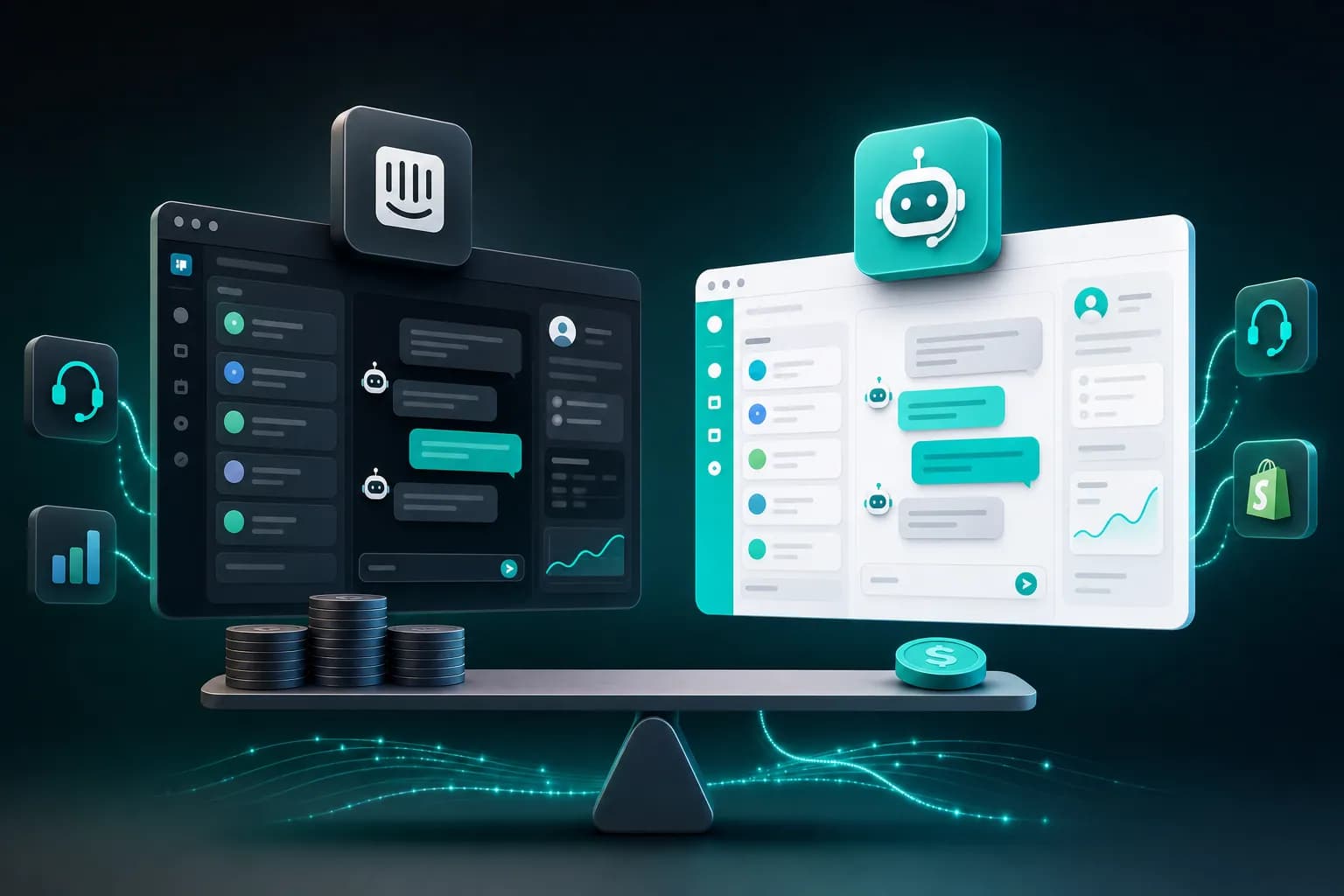
At $500–$1,400 per month, small businesses are spending $6,000–$16,800 annually on customer support software alone. For a bootstrap SaaS company doing $50k MRR or a Shopify store with $10k monthly revenue, that's 10–15% of gross revenue. That math doesn't work.
KnowDesk costs $99–$299 per month for full features, including the WISMO agent (a trained AI that answers questions from your docs), live agent inbox, brand gate, and QA reviews. That's $1,188–$3,588 per year. The difference matters when you're bootstrapped.
| Feature | KnowDesk | Intercom | Advantage |
|---|---|---|---|
| Monthly Price (baseline) | $99 | $499 | KnowDesk |
| Setup Time | < 2 minutes | 4–6 hours | KnowDesk |
| AI Support Agent | WISMO (included) | $15/month + setup | KnowDesk |
| Native Notion/Docs Sync | Yes | No (requires Zapier) | KnowDesk |
| No-Code Deployment | Copy/paste widget code | Requires developer | KnowDesk |
| Knowledge Base Sync | Real-time (Notion, Docs, Confluence, PDF) | Manual imports only | KnowDesk |
| Brand Gate (custom domain) | Included | Premium add-on ($$$) | KnowDesk |
| Live Agent Inbox | Yes | Yes | Tie |
| QA Reviews | Built-in | Custom workflows | KnowDesk |
KnowDesk's Sub-2-Minute Setup vs. Intercom's Day-Long Onboarding
Here's where the comparison gets concrete. When you sign up for Intercom, you're walked through a 6-part setup flow: brand color, company description, team member invitations, initial messaging rules, integration with Shopify/Stripe/Help Scout, and payment. By step 4, you're in a dialog tree explaining to Intercom what you want the Messenger to do. You'll spend an hour just configuring automation rules.
KnowDesk works differently. You sign up, connect one source (Google Docs, Notion, Confluence, PDF, or Shopify FAQ), and copy a snippet of code into your website's header. The widget appears within seconds. Your knowledge base syncs automatically. The WISMO agent reads your docs and starts answering questions. Total friction: 90 seconds.
This matters. A small business operator doesn't have 6 hours to set up customer support infrastructure. They have 10 minutes before they need to go back to product work. KnowDesk respects that reality.
Let's make this concrete with a real scenario. You run a Shopify store selling fitness equipment. A customer emails: "Does this dumbbell come in 35 lbs?" Your help center has an FAQ page saying "Available in 10, 25, 35, 50 lbs." With Intercom, you'd need to manually write a bot rule to catch that question, assign it to the FAQ, and test it. With KnowDesk, the WISMO agent reads your Shopify FAQ automatically and answers it on the spot. No configuration needed.
Knowledge Base Integration: KnowDesk Wins Decisively
Small businesses already have their answers documented somewhere. Maybe it's a Google Doc with your onboarding steps. Maybe it's a Notion database of FAQs. Maybe you have a Shopify store with product descriptions that answer 80% of questions.
Intercom doesn't integrate with these tools natively. You can use Zapier (a third-party automation tool), but that adds cost, complexity, and another service to manage. You're also syncing data one-way, one time. If you update your Notion page, Intercom doesn't know about it until you manually re-sync.
KnowDesk syncs directly from Google Docs, Notion, Confluence, Shopify, and PDFs in real-time. Update your FAQ? The WISMO agent sees it immediately. Add a new product to your Shopify store? KnowDesk's knowledge base includes it within minutes. You're not managing two systems; you're pointing KnowDesk at the truth once and letting it stay current.
This saves time every week. With Intercom, support updates mean manual work. With KnowDesk, support evolves with your business automatically.
Real-World Example: E-Commerce Store Owner
Sarah runs a Shopify store selling skincare products. She has a Notion database with answers to common questions: "What's your return policy?" "How do I track my order?" "Do you ship internationally?" Intercom can't read Notion natively, so Sarah either recreates those answers in Intercom's knowledge base (2 hours of work) or uses Zapier (requires payment + setup time). KnowDesk connects to her Notion database in one click. When Sarah updates a policy or adds a new FAQ, KnowDesk sees it automatically. The WISMO agent answers customer questions using her Notion data. Result: Sarah never touches the support system again.
The WISMO Agent: AI Support That Actually Works
Intercom's AI (called "Fin") is marketed as a conversation assistant. In practice, it asks clarifying questions and hands off to a human. It's trained on general knowledge, not your business. A customer asks "Can I return my order after 30 days?" and Fin says "I'm not sure, let me connect you to an agent." You're back to square one.
KnowDesk's WISMO agent is different. It's trained on your knowledge base—your docs, your Notion pages, your PDFs, your Shopify FAQs. A customer asks about your return policy, and WISMO answers it directly using your exact policy. It solves problems. It deflects tickets. It reduces your team's workload.
The metrics matter here. Businesses using WISMO report a 75%+ deflection rate, meaning the AI agent fully resolves questions without escalating to a human. With Intercom's Fin, escalation rates sit at 40–50%. That means your team spends less time answering routine questions and more time on complex issues or sales.
Also consider accuracy. Intercom's Fin gives generic answers trained on public data. WISMO gives your answers, your way, using your voice. Customers get consistent, accurate responses that match your brand.
Setup Example: SaaS Onboarding Support
You're a SaaS founder with a 15-page onboarding guide in Confluence. Questions come in constantly: "How do I set up SSO?" "What's the API rate limit?" "How do I bulk-import users?" With Intercom, you'd either answer these manually or write Fin rules to pass them to agents. With KnowDesk, you connect to Confluence once, and WISMO reads all 15 pages. When a user asks "What's the API rate limit?", WISMO pulls the exact section from your docs and answers it. You get a 75%+ deflection rate immediately.
Brand Control and Custom Domains (Intercom Charges Extra; KnowDesk Includes It)
When a customer interacts with your support widget, they're forming an impression of your brand. A generic Intercom Messenger with the Intercom logo doesn't reinforce your identity. Intercom's white-label option—the "brand gate"—comes as an add-on you'll pay hundreds extra per month to use.
KnowDesk includes the brand gate at every price tier. Your custom domain, your logo, your colors, your domain name in the URL. When customers visit your help center or chat widget, they see your brand, not KnowDesk's.
This is standard in 2026, not a premium feature. Small businesses shouldn't pay extra for basic brand control.
Live Agent Inbox and Mission Control
Both KnowDesk and Intercom include a live agent inbox where your team can see incoming conversations. The difference is in the surrounding features.
Intercom's inbox is functional but basic. You see conversations, you reply, you manage them. That's it. Managing quality requires you to build custom workflows or use third-party tools.
KnowDesk's Mission Control is built for small teams. It includes:
- QA reviews—review and improve agent responses before they're sent, catching mistakes and ensuring consistency
- Email retention agent—automatically capture and organize emails so no customer question falls through the cracks
- Conversation tagging—label conversations (feature request, bug report, billing) so you spot patterns and prioritize backlog work
- Team performance analytics—see response times, resolution rates, and customer satisfaction by agent, without a separate tool
- Multi-language support—conversations automatically translate, so you support customers globally without hiring multilingual staff
These features exist in Intercom, but you have to find them in different products or pay for them separately. KnowDesk gives them to you at $99–$299/month.
Shopify Integration: Native vs. Workaround
If you're an e-commerce business, this comparison is critical. Intercom integrates with Shopify—technically. You connect your Shopify store, and Intercom can see customer order data when a customer starts a chat. The integration is read-only. You can't initiate outreach based on order status, sync product FAQs automatically, or use Shopify data to train your support AI.
KnowDesk's Shopify app is deeper. You sync your product catalog directly. Your FAQ is your Shopify FAQ, always up to date. The WISMO agent has full context about your products, inventory, and policies. Your support team can see full order histories without switching windows. You're working inside one system that understands your business.
Small Shopify stores especially need this. You're already managing products in Shopify; you don't want to maintain separate FAQs in Intercom.
Getting Started with KnowDesk: Why Small Businesses Choose It
The decision is clear when you look at specifics. You can start a free trial of KnowDesk immediately, and you'll see why. Deploy a widget in 2 minutes. Sync your Notion page or Shopify FAQ. Watch the WISMO agent answer customer questions using your knowledge base. It works differently because it's built for small teams, not enterprise operations.
KnowDesk isn't trying to be Intercom. Intercom is built for companies with large support teams, custom workflows, and budgets to match. KnowDesk is built for the founder, the small team, the person who needs support now and doesn't want to learn 40 features to get it.
Cost matters when you're bootstrapped. Setup time matters when you're wearing 10 hats. Knowledge base sync matters when you're already documenting your business in Notion or Docs. AI deflection matters when your time is your most valuable resource.
All of these favor KnowDesk. No marketing spin needed—the numbers, features, and setup process speak for themselves.
Why KnowDesk Wins for Small Businesses in 2026
The support software market has matured. In 2026, small businesses have options. But they also have constraints: limited budgets, small teams, and no time for complex setups. Intercom was built for a different era and a different customer.
KnowDesk recognizes that small business support in 2026 is about automation, not about beautiful interfaces. It's about using AI to handle routine questions so your team can focus on the relationships and decisions that actually drive your business. It's about integrating with the tools you already use—Notion, Docs, Confluence, Shopify—instead of forcing you into a new system.
The choice is straightforward:
- If you need enterprise-grade workflows, multiple support teams, and advanced reporting, Intercom is built for that (and you can afford the $500+/month)
- If you're a small team looking for AI-powered support, real-time knowledge base sync, sub-2-minute setup, and 70% cost savings, KnowDesk is the answer
- If you run a Shopify store and want your product FAQ to power your support automatically, KnowDesk's integration is unmatched
- If you document everything in Notion and want that to become your support knowledge base without manual re-entry, KnowDesk is the only choice
- If you want QA reviews, email capture, and multi-language support without building custom workflows, KnowDesk includes them
Small business owners are choosing KnowDesk because it respects their time and their budget. Try it yourself. Start a free trial with no credit card required. Deploy the widget on your site in under 2 minutes. Connect your knowledge base—Notion, Docs, Confluence, PDF, or Shopify. Watch the WISMO agent handle your customer questions. You'll understand immediately why Intercom isn't the only option anymore, and why thousands of small teams have already made the switch in 2026.