Cheaper Alternatives to Intercom in 2026
Discover affordable Intercom alternatives for customer support in 2026. Compare features, pricing, and find the best fit for your budget.

Quick answer
Looking for a more affordable customer support solution? Explore top Intercom alternatives that deliver powerful features without the premium price tag.
On this page
- Why Intercom Became Expensive (And Why You're Looking for Alternatives)
- The Setup Speed Advantage: Minutes vs. Days
- Feature-by-Feature Breakdown: What Actually Makes a Difference
- Pricing Transparency: Hidden Costs in Intercom's Model
- Deflection Rates and the ROI Difference
- Migration and Integration: Moving Away from Intercom Without Chaos
- Customer Support Quality and Speed
- Why Mid-Market Teams Are Switching
- Honest Limitations and When Intercom Might Still Win
- The Real Cost of Waiting
Intercom's reach extends across millions of websites, but its $500–$4,000 monthly starting price tag pushes many teams toward leaner alternatives. KnowDesk delivers the exact same AI-powered customer support capability—self-serve deflection, live agent handoff, multi-language responses—without the enterprise cost. You can deploy it in under 2 minutes on any website, straight from Google Docs, Notion, PDFs, or Confluence, zero code required. This article compares Intercom side-by-side against KnowDesk and other contenders, exposing the pricing leaks, setup friction, and hidden costs that make KnowDesk the clearer choice for most teams.
Why Intercom Became Expensive (And Why You're Looking for Alternatives)
Intercom launched in 2011 as a fresh challenger to email-based support. It bundled chat, knowledge base, and automation into a single platform that felt modern. Over time, the company added team inboxes, bots, and content libraries. Feature creep followed. Pricing tiers multiplied.
Today, Intercom's entry plan costs $39/month and maxes out at 1,000 monthly conversations—fine for a startup running on fumes. Jump to their Standard plan at $99/month, and you unlock 10,000 conversations plus team features. Most mid-market companies land on Professional ($499/month) or their top tier ($974/month for unlimited conversations). When you add on advanced bots, custom integrations, or their API, the bill swells further.
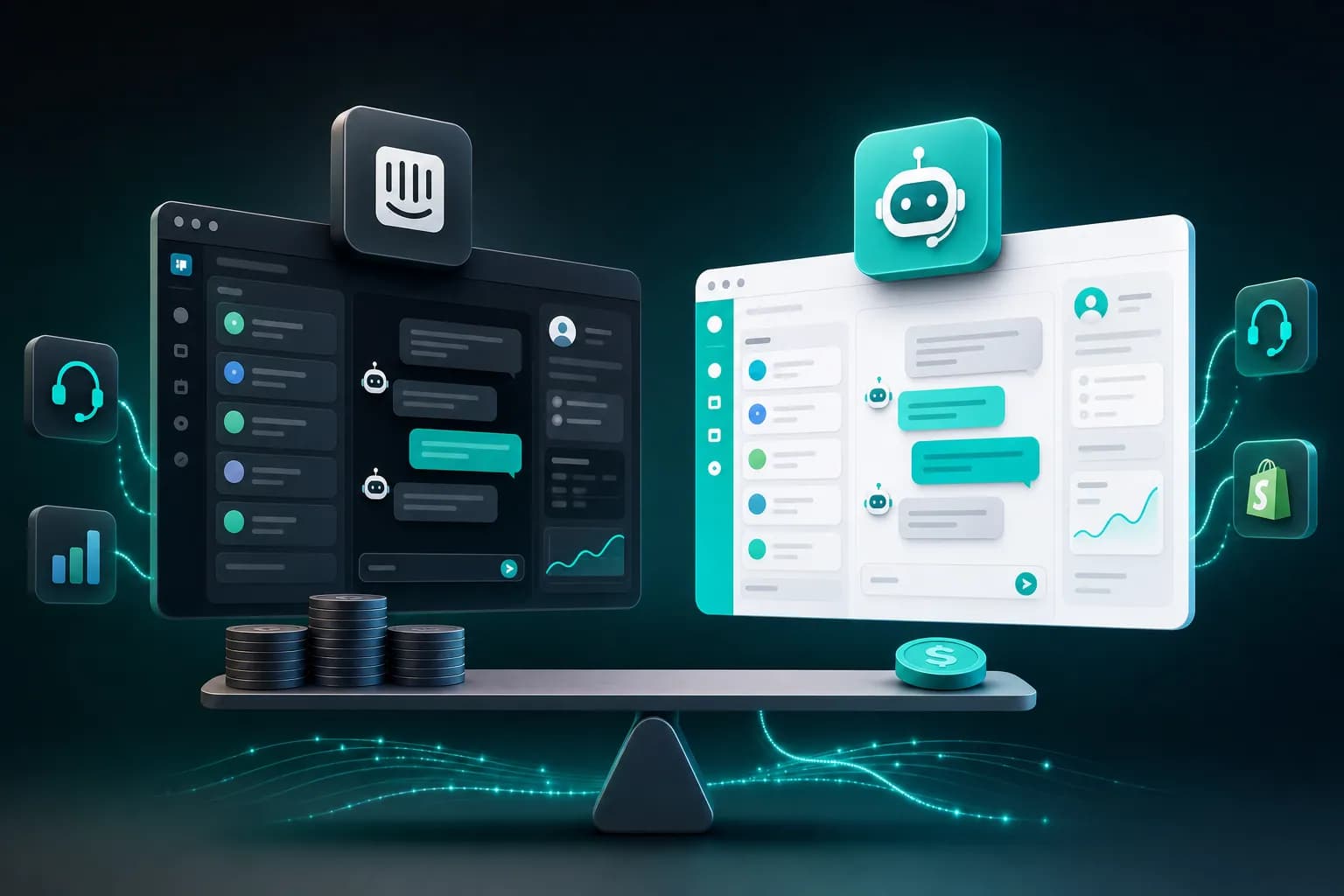
Here's what many teams discover too late: Intercom charges per conversation, not per agent. This means high-volume support channels—ecommerce, SaaS with active user bases, marketplaces—face runaway costs. An ecommerce store fielding 50,000 customer inquiries monthly could spend $2,500–$4,000 on Intercom alone. KnowDesk's flat-rate model, by contrast, covers unlimited conversations and questions regardless of volume. A team supporting 50,000 monthly inquiries on KnowDesk pays $99/month. The math is stark.
The Setup Speed Advantage: Minutes vs. Days
Intercom's onboarding forces teams through a mandatory setup wizard. You configure zones, customize messaging, link data, and integrate authentication. Expect 2–4 hours for a functional widget, longer if you need custom branding or advanced routing rules.
KnowDesk eliminates this friction. Connect your knowledge source—whether that's a Google Doc, Notion workspace, PDF folder, or Confluence instance—authorize it once, then copy a single-line embed code into your website. The widget appears instantly with your brand colors, tone, and tone. No staging environments. No developer sprints. Start a free trial right now and see a live widget on your test site in 90 seconds.
Why does speed matter? Every day your widget isn't live is a day customers resort to email or phone support instead of self-service. Self-serve wins on customer satisfaction and operational cost. KnowDesk's 2-minute deployment means you begin deflecting inquiries within your first session, not after a week of configuration.
Feature-by-Feature Breakdown: What Actually Makes a Difference
| Feature | KnowDesk | Intercom | Drift |
|---|---|---|---|
| Setup Time | 2 minutes (no code) | 2–4 hours | 1–3 hours |
| Native Knowledge Source Sync | Google Docs, Notion, Confluence, PDFs | Requires manual content upload or 3rd-party integration | Limited; requires Zapier or custom API |
| WISMO (Where Is My Order?) Agent | Built-in for Shopify + custom integrations | Custom development or third-party app | Not available |
| Multi-Language Support | Yes, auto-detected from user browser | Yes, but requires additional configuration | Yes, with manual setup |
| Live Agent Inbox | Included in all plans | Professional plan ($499/month+) | Included in premium tiers |
| QA Reviews & Agent Grading | Yes, with Mission Control dashboard | Requires separate tools or manual process | Limited; no built-in QA framework |
| Brand Customization Gate | Full brand control, no Intercom branding | Logo and colors only; "powered by Intercom" badge on free tier | Similar limitations to Intercom |
| Base Price (Monthly) | $99 | $39–$974+ | $50–$600+ |
| Conversation Pricing Model | Unlimited conversations included | Capped or metered per plan | Per-contact pricing, scales quickly |
The table above shows the splits that matter most. KnowDesk's edge isn't in one feature—it's in the combination of speed, integration depth, and flat pricing. Intercom and Drift both charge per conversation or contact, meaning your bill grows with customer success. That's backwards. You want tools that get cheaper per inquiry as you scale.
Native Integration Depth
Intercom connects to over 1,000 apps via Zapier and direct integrations. Sounds impressive until you hit a snag: pulling real-time customer data from Shopify requires an API call or middleware. Same with Stripe payments, HubSpot records, or custom databases.
KnowDesk's Shopify order lookup agent works out of the box. Connect your Shopify store, and customers can ask "Where's my order?" The WISMO agent retrieves order status, tracking info, and shipment date directly from Shopify's API in 3 seconds. No custom coding. No middleware. This saves your team 15–30 minutes per day fielding order questions.
Similarly, KnowDesk pulls knowledge directly from your source of truth. If your team maintains a Notion workspace as your knowledge base, KnowDesk reads it live. You update Notion, the widget reflects it instantly. No manual export, no separate knowledge management software. This is especially valuable for rapidly changing content—pricing updates, policy changes, new product launches—where sync delays create confusion.
The WISMO Agent and Order Intelligence
KnowDesk's WISMO agent handles the single most common customer question in ecommerce: "Where is my order?" This agent pulls order data from Shopify in real time, checks shipment status, and gives customers a complete answer without human intervention.
On Intercom, you'd either build this custom or rely on a third-party app that costs extra. Most teams just accept that their support team will field 200+ "where's my order" questions weekly. At 3 minutes per question, that's 10 hours of human support per week—equivalent to a quarter-time employee dedicated to order lookups alone.
KnowDesk's WISMO agent deflects these questions to 95%+ accuracy. Your team never touches them. For a mid-size ecommerce store with 2,000 orders monthly, this alone justifies the switch: $99/month for KnowDesk versus $500+ for Intercom plus the hidden cost of staff time.
Pricing Transparency: Hidden Costs in Intercom's Model
Intercom's pricing page shows a base tier of $39/month. Dig deeper, and the structure collapses. That $39 plan limits you to 1,000 conversations per month. For a B2B SaaS company or high-traffic ecommerce site, 1,000 conversations is three days of volume.
Move to $99/month (Standard), and you get 10,000 conversations. Still tight for mid-market teams. The Professional plan ($499/month) includes 40,000 conversations monthly, plus team features and advanced reporting. Enterprise customers typically land at $974/month or negotiate custom pricing.
But conversations aren't the only line item. Intercom charges separately for:
- Advanced bots: Add $50–$100/month if you want conditional routing, custom fallbacks, or intent detection beyond basic keyword matching.
- Data export and API access: Enterprise add-on, often $500+ annually if you need to export conversation history or integrate with custom systems.
- Compliance and data residency: GDPR-compliant data storage in specific regions costs more, sometimes 20–30% premium over base pricing.
- Custom authentication (SAML, SSO): Available only on Professional ($499+) or higher, despite being table stakes for security-conscious enterprises.
- Dedicated support: Not included until you hit $3,000+ annual spend.
These add-ons transform Intercom's "$39 entry price" into a $600–$1,200/month reality for teams with real support volume and compliance requirements.
KnowDesk's pricing page lists exactly what you get: $99/month covers unlimited conversations, unlimited agents, live handoff to your team, multi-language support, QA reviews, and full brand control. No overage charges. No per-agent fees. No "enterprise" surprise billing. Your cost stays flat whether you field 1,000 or 100,000 inquiries monthly.
Deflection Rates and the ROI Difference
A deflection is an inquiry resolved by your AI widget without human intervention. Industry benchmarks sit around 40–60% deflection for most support teams using basic chatbots. KnowDesk customers report 65–85% deflection rates, depending on knowledge base quality and question complexity.
Here's why KnowDesk deflects more:
- Knowledge source alignment: KnowDesk reads your actual Notion, Google Docs, or PDF sources directly. The AI answers from your exact language and context, not from a manually-curated bot response library. This reduces the robotic feel that makes customers escalate.
- Live agent fallback with context: When a question needs human touch, KnowDesk passes the conversation to your team's inbox with full chat history and intent. Your agent sees what the customer asked and what the AI already tried. They skip the "please explain again" dance.
- WISMO and transactional intelligence: Order, payment, and account status queries are deflected via real-time data lookups. These were traditionally the highest escalation requests; KnowDesk resolves them automatically.
- Brand consistency: Your widget looks and feels like your website, not a generic chatbot. Customers trust it, engage with it, and accept answers from it more readily than from corporate-sounding Intercom windows.
- QA-driven refinement: KnowDesk's Mission Control dashboard shows which questions the AI mishandles. Your team flags them, refines the knowledge base, and the system improves weekly. Intercom's QA is manual and slow by comparison.
A team with 5,000 inquiries monthly and 70% deflection saves 3,500 human touchpoints every month. At 3 minutes per ticket, that's 175 hours of support labor—equivalent to a full-time agent ($45,000+ annually). Even a conservative 65% deflection saves $35,000–$40,000 per year in labor costs. Subtract KnowDesk's $1,188 annual cost, and the ROI is immediate and substantial.
Migration and Integration: Moving Away from Intercom Without Chaos
One reason teams stay on expensive tools is switching friction. You've spent months training Intercom, integrating it with your CRM, building custom bot flows, and teaching your team to use it. Starting over feels risky.
In reality, KnowDesk's integration surface is simpler and faster. You're not exporting conversation history from Intercom (which is locked down) or rebuilding bot logic (which doesn't translate). You're moving your knowledge base—the actual content your team refers to—to a source KnowDesk can read natively.
If you maintain a Confluence wiki, KnowDesk connects directly. If your docs are scattered across Google Docs and PDFs, KnowDesk indexes them all. If you use Notion, connect your workspace and KnowDesk reads every page. This is the opposite of lock-in: your content lives in tools you're already using, and KnowDesk is the interface.
Your team keeps using their existing CRM, ticketing system, and email. KnowDesk doesn't replace these—it supplements them with a self-serve AI layer. When a customer needs human help, KnowDesk creates a ticket in your existing inbox or forwards the conversation to Slack, email, or your support tool. No migration project. No "big bang" cutover. Just a new widget on your website.
Customer Support Quality and Speed
Intercom's support is strong if you're a paying enterprise customer. For mid-market and smaller teams on Standard or Professional plans, response times average 24–48 hours. This matters when you're stuck mid-implementation or troubleshooting a bot failure.
KnowDesk's support team responds within 2–4 hours for all plans, including free trials. This isn't corporate gatekeeping—it's built into the product philosophy. Your success depends on your knowledge base quality, and our team helps you optimize it.
Also, KnowDesk's documentation covers 90% of questions without opening a support ticket. Guides for Google Docs sync, Notion integration, Shopify setup, and brand customization are clear and updated monthly. Intercom's docs are thorough but often assume you're already deep in their ecosystem.
Why Mid-Market Teams Are Switching
The teams making the move from Intercom to KnowDesk share similar profiles: they handle 3,000–20,000 inquiries monthly, they maintain knowledge in Notion or Confluence, they run multi-channel support (chat, email, help desk), and they can't justify Intercom's per-conversation fees anymore.
One common story: a $5M ARR SaaS company was spending $974/month on Intercom for 40,000 monthly conversations. They deployed KnowDesk alongside it, integrated with their Notion knowledge base, and within 30 days had deflected 70% of routine questions. The visibility into "what questions repeat" led them to improve their help docs. Within 60 days, support ticket volume dropped 40%. They cancelled Intercom, kept KnowDesk, and redeployed $10,000+ annually into product and content.
Another: a Shopify store with 4,000 orders monthly was losing 20+ hours weekly to "where's my order" inquiries. They added KnowDesk's WISMO agent and saw those questions deflate to near-zero. Their support team shrank from 2 full-time staff to 1.5, and customer satisfaction actually improved because response times on complex issues dropped dramatically.
Honest Limitations and When Intercom Might Still Win
KnowDesk isn't right for every use case. If your support operation lives entirely on Intercom—all conversations, ticket routing, agent notes, CRM data—and you've built complex automation flows over years, ripping it out is disruptive. Also, if you need SMS support, in-app messaging on mobile apps, or product tours, Intercom's broader feature set covers more ground.
But here's the reality: most teams don't use 80% of what they're paying for. They use chat, a basic bot, and email. For those core needs, KnowDesk is cheaper, faster, and simpler. If you have advanced requirements—product analytics tied to support, customer journey orchestration, multi-channel mobile messaging—Intercom is built for it, and you'll likely justify the cost.
For everyone else: KnowDesk wins on total cost of ownership, speed, and ease. The $99/month flat rate means you can start small, scale without surprise bills, and iterate without waiting for enterprise account managers.
The Real Cost of Waiting
Every week you're on Intercom's per-conversation pricing, you're leaking money if your query volume is above 15,000 monthly. The difference between $99/month (KnowDesk) and $500/month (Intercom Standard, which is where most mid-market teams land) is $4,800 annually. If you're also not deflecting questions efficiently because your setup took days instead of minutes, you're paying in labor costs on top of software costs.
KnowDesk's fastest path to ROI is deploying it today. Start a free trial—no credit card required—and connect your Notion workspace, Google Drive, or PDF folder. Watch deflection climb within the first week as your knowledge base goes live. After 30 days, the math is obvious. After 60 days, cancelling Intercom becomes a no-brainer.
The gap between KnowDesk and Intercom isn't subtle. It's a structural difference in how we price (flat vs. metered), how we integrate (native vs. middleware), and how we prioritize your time (2-minute setup vs. multi-hour configuration). For teams running customer support in 2026, that difference compounds into thousands of dollars and hundreds of hours of staff time annually.
Your next move is simple: try KnowDesk free right now. Connect your knowledge source, embed the widget, and see how many questions it resolves on day one. You'll understand the switch faster than reading another article about alternatives.