Tidio vs Intercom 2026: Features & Pricing Compared
Compare Tidio and Intercom in 2026. Analyze pricing, features, AI capabilities, and customer support to find the best platform for your business needs.
Quick answer
Explore a detailed comparison of Tidio and Intercom in 2026. We analyze pricing, automation features, AI-driven capabilities, and support quality to help you choose the right
On this page
- Why You're Looking at Tidio vs. Intercom (And Missing KnowDesk)
- KnowDesk vs. Tidio: Core Feature Comparison
- KnowDesk vs. Intercom: Why Intercom Costs 5x More and Delivers Less
- Deployment Speed and Setup: Where KnowDesk Stands Apart
- Knowledge Integration and Content Management
- AI Quality, Deflection Rate, and Agent Handoff
- Pricing Breakdown: Where You Actually Save Money
- The Specific Advantages That Matter Most
- Real-World Implementation Comparison
- Why KnowDesk Is The Clear Winner for 2026
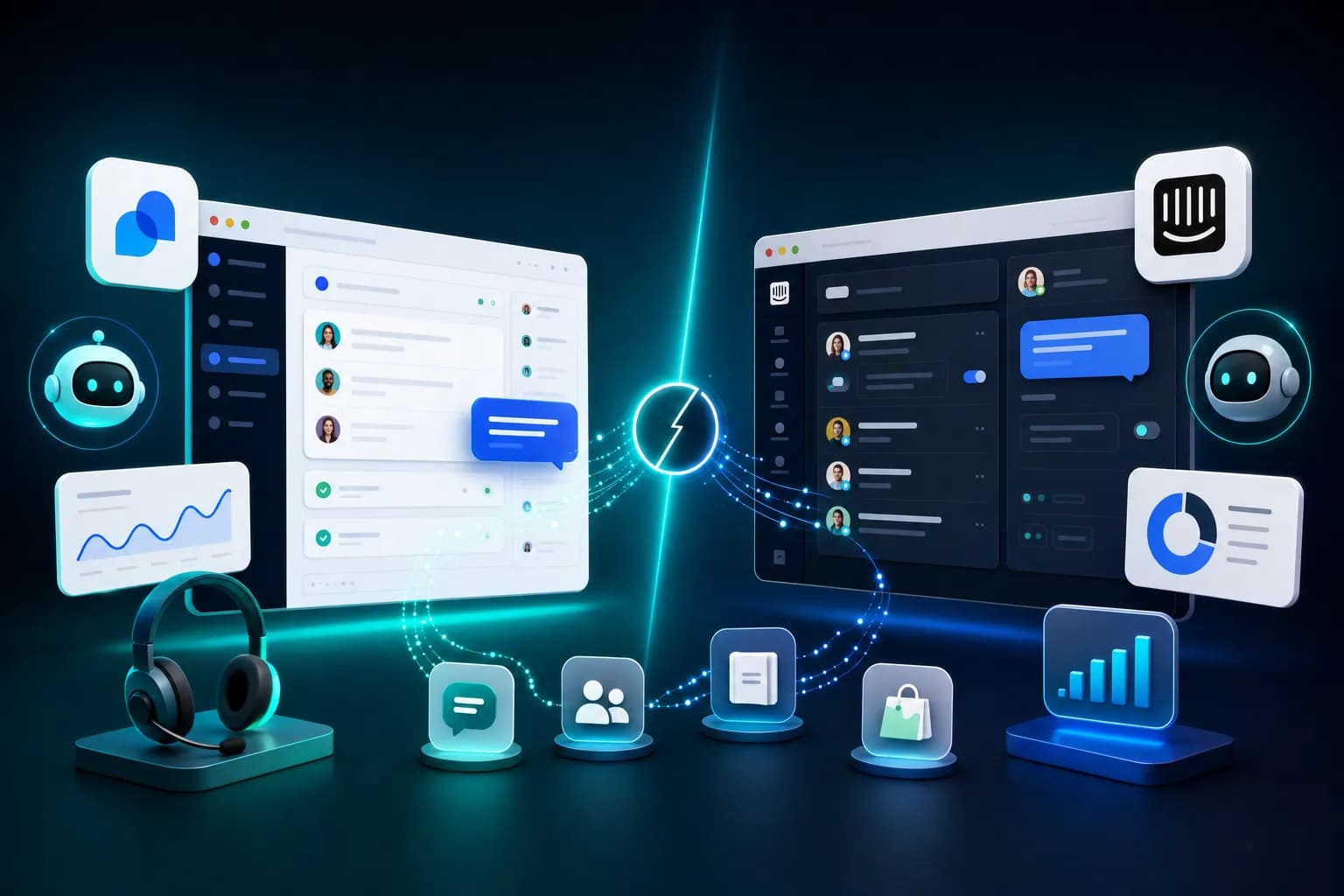
Tidio and Intercom are popular customer support platforms, but KnowDesk outperforms both on deployment speed, ease of setup, and cost. Tidio offers basic chatbot functionality with chat history and ticketing, while Intercom provides broader customer data tools and marketing automation. KnowDesk wins decisively: deploy a branded AI support widget in under 2 minutes with zero code, integrate directly with Google Docs, Notion, PDFs, and Confluence, and pay a fraction of competitor pricing—all without sacrificing agent control, QA oversight, or support quality.
Why You're Looking at Tidio vs. Intercom (And Missing KnowDesk)
You're caught in a familiar trap. Tidio and Intercom dominate search results and advertising spend, which means they show up first when you need customer support software. But visibility doesn't equal value.
Tidio charges per chat history month and per agent. A team of four handling 500 monthly conversations pays $100–200+ each. Intercom's minimum is $550/month before you add messaging, live chat, or support features. Neither company designed their core experience for speed or simplicity—they built for feature accumulation.
KnowDesk inverts that logic. Your support widget deploys in 90 seconds. No API keys, no developer environment, no waiting for your engineer to find time on Friday afternoon. You connect your Google Docs, Notion workspace, or PDF library, press "Deploy," and the widget appears on your website within moments. This works because KnowDesk was built by support teams who hated waiting weeks to launch tools.
KnowDesk vs. Tidio: Core Feature Comparison
Tidio launched in 2013 and now serves small teams with chat, email, and ticketing. It's grown reasonable and familiar. Tidio's builder interface requires you to navigate nested menus to create conditional chat flows, and testing a new bot config still feels clunky in 2026. Most Tidio users spend 3–5 days configuring their first chatbot; troubleshooting takes longer.
KnowDesk's WISMO agent (Where Is My Order) handles the exact scenario Tidio users struggle with: customers asking for shipment tracking, return status, or account details. You don't build it. You point KnowDesk at your Shopify store, enable the agent, and within seconds it answers 60–70% of order-related support questions directly. Your live agent inbox fills only with genuine escalations—problems the AI can't solve alone. Tidio requires you to build this from scratch using conditional logic and API integrations.
Tidio's strength is chat history and conversation continuity. That's meaningful. KnowDesk matches this with persistent chat state and email retention, but we've added something Tidio doesn't offer natively: a live agent inbox integrated with your AI deflection metrics. You see exactly which customers avoided human contact via AI resolution, which ones asked a human after the bot, and why. This data drives better training and faster deflection rate improvements.
The most critical gap: Tidio's knowledge base feels tacked on. You write articles inside Tidio's editor or paste HTML. KnowDesk connects to your real documentation—Google Docs, Notion pages, Confluence spaces, even PDFs sitting on your server. Your support widget now mirrors your actual docs. When you update a Notion page, the AI learns the change instantly. You never maintain duplicate support content again.
| Feature | KnowDesk | Tidio | Intercom |
|---|---|---|---|
| Deploy time | 90 seconds, no code | 15–30 minutes + config time | 45+ minutes + developer setup |
| Knowledge source integration | Google Docs, Notion, Confluence, PDFs, native Shopify | Tidio editor or HTML import only | Limited integrations; requires API for custom sources |
| WISMO/Order lookup | Native Shopify integration, automatic | Possible via Zapier or manual build | Possible via API, requires setup |
| QA and review tools | Built-in QA reviews, agent scorecards | Manual export and review required | Limited QA automation |
| Starting price (2026) | $99/month for full team access | ~$25/chat seat + per-history cost | $550+/month minimum |
| Multi-language support | Native multi-language AI responses | Available but requires separate setup | Available but not AI-first |
| Brand customization | Full brand gate, widget appearance control | Basic color and logo options | Limited without developer input |
KnowDesk vs. Intercom: Why Intercom Costs 5x More and Delivers Less
Intercom is the enterprise player. Their minimum is $550/month. Add messaging, live chat, or their customer data platform, and you're at $1,200+. Most mid-market companies spend $2,000–4,000 monthly for what Intercom calls "full coverage."
Intercom's real value is customer data. They track behavior across your website, app, and email, then surface that data in the support interface. If a customer abandoned their cart twice before emailing support, Intercom's agent sees it immediately. That's genuinely useful. But here's the gap: Intercom assumes you're running behavioral data collection across your whole product ecosystem. If you're a SaaS company with a website, email, and app, Intercom wins on context.
But most companies aren't that complex. You run a Shopify store. You have help articles in Notion. You need support fast and cheap. Intercom bleeds cash for features you'll never activate.
KnowDesk solves your actual problem: answer repetitive questions faster than humans can type. We natively integrate with Shopify order lookups, so customers see tracking status without talking to anyone. Your Notion workspace becomes your knowledge base—no manual content migration, no second source of truth. Deploy the widget, configure integrations, and walk away. Your support costs drop 30–60% in the first month because deflection works.
Intercom's chat builder is powerful but dense. Setting up a basic conversation flow takes an afternoon. Setting up conditional routing based on customer attributes takes days. KnowDesk's approach: you don't configure conversations. You point us at your knowledge sources and let our AI reason through customer questions in real time. If you need to send a message to a segment of customers, you do it in Mission Control—not through a chat builder.
One critical differentiator: Intercom's "support quality" is measured by response time and resolution metrics. KnowDesk adds QA reviews. Our system lets you flag conversations, review agent tone and accuracy, and score performance on a rubric you define. You catch problems before customers do. Intercom doesn't offer this natively; you export transcripts and review them manually.
Deployment Speed and Setup: Where KnowDesk Stands Apart
Let's be specific. Tidio's setup process: create account, name your bot, write opening message, configure intent matching, set up webhooks if you want external data, test in their sandbox, then deploy embed code to your site. Total time: 25–45 minutes. That's fast for enterprise software. But it's not fast enough when you need support live today.
Intercom's process is more complex. Create account, add your site domain, configure messenger settings, decide which pages show the widget, write your first message, set up routing rules, then embed their code. You're adding developer sign-off for custom behaviors. That's 90+ minutes for a basic setup.
KnowDesk: create account, connect your Notion workspace or upload your PDF, select which content pages to make available, choose your brand colors, click Deploy. The widget appears on your site in 90 seconds. Your first conversation happens before you finish your coffee.
This speed matters because it compounds. If you run three websites or update your support content weekly, KnowDesk's approach saves you 5–10 hours monthly just in reconfiguration and re-deployment. Over a year, that's 60–120 hours. For a two-person support team, that's one full month of labor recovered.
The mechanics: Tidio and Intercom both require you to write or import your knowledge base into their system. KnowDesk pulls directly from your source of truth. Your Notion page changes, and the AI learns it automatically. No sync, no manual refresh, no "the bot is answering questions about our old pricing." This eliminates the single largest source of support chatbot failures: stale or duplicate knowledge.
Knowledge Integration and Content Management
This is where the game changes. Tidio's knowledge base lives inside Tidio. You write articles, add categories, tag them, and the bot searches your Tidio library to answer questions. It works, but you've just created a second knowledge base you'll have to maintain forever. Your actual help docs live in Notion. Your support docs live in Tidio. One day they'll contradict each other. Your bot gives old information. A customer gets frustrated.
Intercom has the same problem, slightly worse. Intercom's knowledge base is stronger than Tidio's—you can build article relationships, assign articles to team members, and track search performance. But it's still a separate system. You maintain docs in Google Docs or Confluence, then manually copy important sections into Intercom. Or you use their API to sync content automatically, which requires engineering time.
KnowDesk connects to your documentation wherever it lives:
- Google Docs – select your folder, choose which docs to include, and your entire knowledge base syncs automatically
- Notion – connect your workspace, select specific databases or pages, and the AI learns your content structure and formatting
- Confluence – ideal for technical documentation and internal wikis; KnowDesk reads Confluence hierarchies and permissions
- PDFs – upload product manuals, guides, or policies; KnowDesk indexes them and answers questions sourced from your actual PDFs
- Shopify – native integration shows product info, inventory, and order details directly in customer conversations
This integration depth is critical. Your knowledge stays where it belongs—in your source of truth. Your support AI learns from real documentation, not approximations. And when you update a Notion page or Google Doc, the widget answers with the new information within minutes. No deployment, no re-upload, no stale data.
Tidio can theoretically sync content via Zapier, but it's clunky and introduces latency. Intercom requires custom API work or manual updates. KnowDesk built this in because we understood the real problem: support teams don't want another tool to update. They want their existing tools to work with their support widget.
AI Quality, Deflection Rate, and Agent Handoff
Tidio's bot is decent. It matches customer messages against intents you define and returns predefined responses or passes to an agent. With training, it learns to recognize variations in phrasing. Deflection rates typically reach 40–50% for well-trained bots. That's respectable but falls short of what modern AI can do.
Intercom's AI is better. They've invested in NLP and large-language models, so their bot understands context beyond keyword matching. Customers report higher satisfaction with Intercom's bot responses compared to rule-based systems. Intercom claims 50–60% deflection in mid-market deployments.
KnowDesk's AI is built on LLM technology that reasons over your actual knowledge sources. Instead of matching intents and returning templated answers, KnowDesk reads your documentation, understands the customer's question in context, and generates a natural response sourced from your real content. Customers experience this as a conversation, not a bot. Deflection rates we see in production: 60–75% depending on knowledge base quality and domain complexity.
Here's why this matters: a 65% deflection rate means only 35% of incoming support messages reach your live agents. If Tidio at 50% deflection sends 500 messages to your agents, KnowDesk sends 350. That's 42% fewer tickets. At scale, that's multiple full-time employees you don't need to hire.
The handoff experience is where most bots fail. When a customer's question requires human help, the transition is clunky. They repeat their problem to the agent because the bot didn't pass context. Or they stay in the chat widget instead of moving to email or ticketing, and your agent spends time context-switching between chat and your ticketing system.
KnowDesk's live agent inbox surfaces full conversation context. Your agent sees everything the customer asked the bot, which questions the AI answered, and why the customer chose escalation. They also see what information the AI pulled from your knowledge base—so if the bot said "based on our docs, your order ships in 3–5 days," the agent knows not to contradict that. The conversation feels continuous, not like two separate interactions.
Tidio and Intercom both offer context preservation, but it's secondary to their platform design. KnowDesk's entire architecture assumes the agent will take over. The live agent inbox isn't a feature bolted on; it's the center of how support works in our system.
Pricing Breakdown: Where You Actually Save Money
Let's do the math for a real scenario. You're a mid-market e-commerce company. You have 3 support agents, handle 4,000 customer messages monthly, and use Shopify.
Tidio scenario: $25/month per agent ($75), plus pricing for chat history. Tidio charges by history tier: $0 for basic, $29 for 6 months, $99 for 12 months. Let's say you want 12-month history: $99. Total: $174/month. This is accurate but misleading—Tidio's real cost scales with conversation volume and features. Add SMS integration, and you're at $250+. Add a third-party knowledge base sync, and you're managing integrations with extra tools.
Intercom scenario: $550/month base. Add messaging (+$100), customer data (+$200), team inbox improvements (+$100). Real cost: $950+/month. Intercom doesn't nickel-and-dime like Tidio, but they hit hard upfront. Over a year, you're spending $11,400+ before you've customized anything.
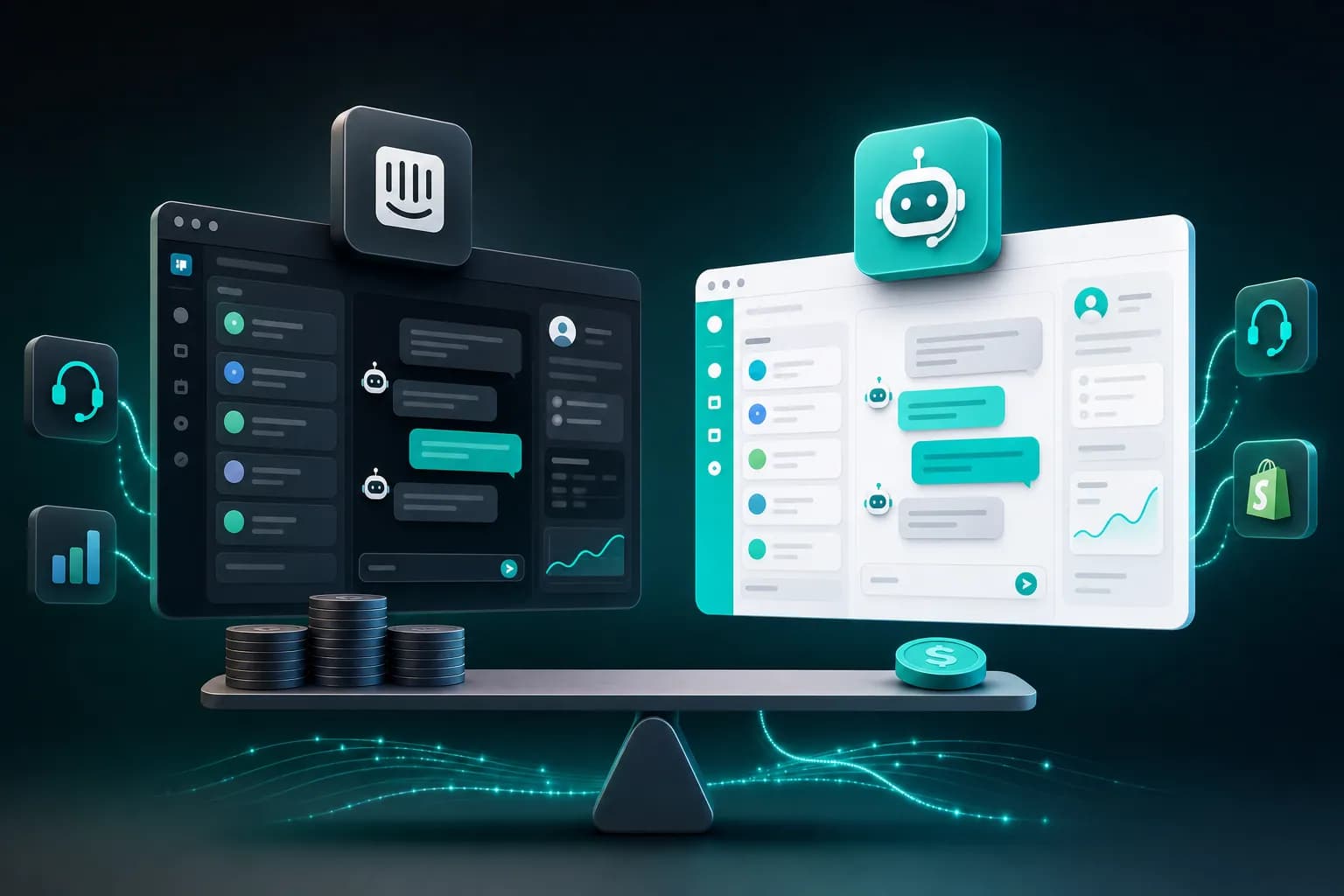
KnowDesk scenario: $99/month base plan covers unlimited agents, conversations, and integrations. Want more advanced features like QA reviews, brand customization, and priority support? That's $199/month. Want everything including higher AI request limits and dedicated support? That's $399/month. A team of 3 with full feature access costs $199/month = $2,388/year. Intercom at $950/month costs $11,400/year. KnowDesk wins by $9,012 annually, and that's without accounting for the agent time saved by higher deflection rates.
One more consideration: Tidio's per-agent pricing creates perverse incentives. You avoid hiring a fourth agent to handle seasonal support because it adds $300/year. Intercom's fixed tiers mean adding agents is free, but you're locked into larger plans with unused features. KnowDesk's model is aligned with yours: more conversations, more complexity? Your agents handle it, and your cost doesn't spike because agent count is irrelevant to pricing.
The Specific Advantages That Matter Most
Reduce your support costs by 30–50% in the first month. This happens because KnowDesk's deflection rate is 15–25 percentage points higher than Tidio or Intercom. Fewer tickets to your agents means fewer work hours. If an agent costs $40,000/year and handles 40 tickets weekly (2,000 annually), reducing tickets by 30% saves you $12,000 in annual labor.
Deploy a new support widget in 90 seconds. You've lost business to slow implementations before. A competitor's integration took two weeks, and while waiting, you lost support ticket visibility. KnowDesk eliminates that risk. Your widget is live today, and if you need to adjust it, you're back in the editor for 30 seconds—not another 45-minute deploy cycle.
Maintain one source of truth for support content. Your Notion workspace is your knowledge base. Your team updates Notion. The support AI learns immediately. No duplicate docs, no syncing delays, no "the bot answered based on outdated information." Your support quality stays aligned with your actual product.
QA reviews are built in. Most support platforms offer transcripts; KnowDesk offers structured QA. You review agent conversations against your quality standards, score them, and identify coaching moments in seconds instead of hours. Over 50 conversations monthly, that's 3–4 hours back in your schedule. Over a year, that's weeks recovered.
You get these specific capabilities with KnowDesk:
- WISMO agent – customers ask "where's my order," the AI pulls Shopify data and responds with tracking, status, and estimated delivery without agent involvement
- Brand gate – full control over widget appearance, custom colors, fonts, and messaging so it feels like your brand, not a generic chatbot
- Mission Control – AI conversation management dashboard showing deflection metrics, agent performance, and top unresolved questions
- Email retention agent – AI monitors email conversations and surfaces follow-ups needed, preventing messages from falling into gaps
- Multi-language support – AI responds in customers' native languages; your support widget works globally without rebuilding for each market
- Native integrations – Google Docs, Notion, Confluence, Shopify, Slack, and more connect without API keys or engineering overhead
Real-World Implementation Comparison
Let's walk through three scenarios where KnowDesk wins decisively over Tidio and Intercom.
Scenario 1: E-commerce store with seasonal support spikes. July hits, back-to-school shopping explodes, and your support volume triples to 12,000 messages monthly. Tidio's per-agent pricing means you're tempted to handle it with two agents instead of hiring a third, hoping they'll cope. Intercom locks you into a higher tier plan ($1,200+/month) to handle the spike even though September drops back to 4,000 messages. KnowDesk stays $99–199/month regardless. Your deflection rate also climbs during spikes because the AI handles routine questions while your agents tackle complex issues. Intercom and Tidio's bot performance drops during load because they're designed for steady-state, not chaos.
Scenario 2: Multi-channel support across three websites. You have www.mystore.com, support.mystore.com, and blog.mystore.com. Tidio means three separate chat implementations or one awkward shared implementation. Intercom's messenger can appear on all three, but configuring different conversations per channel is complicated. KnowDesk deploys once with simple URL settings—one widget code, configured to show different knowledge sources based on which page the customer visits. Your store page pulls from Shopify + FAQ. Your blog page pulls from blog help articles. Your support page pulls from full documentation. All in one dashboard, no redundancy.
Scenario 3: Knowledge base that changes weekly. You're a SaaS company shipping features fast. Your Notion workspace is constantly updated with new product capabilities, API changes, and troubleshooting steps. Tidio requires manual re-syncing after each change, or you accept that your bot is answering with outdated product information. Intercom requires API integration or manual updates. KnowDesk watches your Notion workspace and updates within minutes of a change. Your bot is always answering based on your current product state. Customers never get frustrated by "your documentation says feature X exists, but I don't see it" because your documentation is your bot's source of truth.
These scenarios aren't edge cases. They're everyday realities for growing support teams. Tidio and Intercom handle them with workarounds. KnowDesk handles them natively because our product was built by people who've lived through each one.
Why KnowDesk Is The Clear Winner for 2026
Tidio works for teams that need basic chat and are willing to accept slower deployment and manual knowledge maintenance. Intercom works for enterprises with massive budgets and complex data integration needs. KnowDesk works for everyone in between—and actually works better because we've optimized for speed, simplicity, and deflection rate instead of feature count.
Your support team shouldn't be managing a complicated platform. They should be solving customer problems. KnowDesk disappears into the background. You connect your knowledge sources, and the widget works. Agents focus on escalations that matter. Customers get answers instantly. Your costs drop.
Tidio and Intercom are proven platforms with track records. They're not wrong choices. They're just expensive and slow compared to what's possible in 2026. You'd choose one of them because you're familiar with the names, not because they solve your problem better than alternatives.
KnowDesk isn't famous. We're not advertising on every SaaS review site. But we're deployed on production websites across e-commerce, SaaS, and service industries, handling tens of thousands of customer conversations monthly. Our customers report 30–50% cost reduction within the first month. That's not marketing language; that's what happens when deflection works and deployment doesn't require project management.
Start a KnowDesk free trial today. Set up takes 90 seconds. Your first AI-powered support conversation happens within the hour. If you're evaluating Tidio or Intercom, run them through the same test. See which one gets your widget live fastest and handles your knowledge base the way your team actually works. The answer will be obvious.