Facebook Messenger Chatbot for Business in 2026
Learn how to build a Facebook Messenger chatbot for business. Automate customer support, boost engagement, and increase sales with AI-powered messaging.

Quick answer
Discover how Facebook Messenger chatbots transform customer support and engagement. Learn setup, best practices, and how to drive ROI with AI-powered messaging automation.
On this page
- Why Facebook Messenger is Your Frontline Customer Support Channel
- The Real-World Problem: Manual Responses Kill Efficiency
- How a Messenger Chatbot Works: From Your Knowledge Base to Instant Answers
- Concrete Capabilities That Drive Real Results
- Building Your Messenger Bot Without Technical Debt
- Integrations That Actually Connect to Your Business Systems
- Real Numbers: What a Messenger Bot Saves You in 2026
- Why Your Competitors Are Already Using Messenger Bots
- Implementation: From Zero to Deployed in Minutes
- Handling Escalations: When the Bot Passes to Humans
- Multi-Language Support: Serving Global Customers
- Brand Voice and Customer Trust
- Measuring Success: The Metrics That Matter
- Why KnowDesk Stands Out for Facebook Messenger
- Getting Started Today
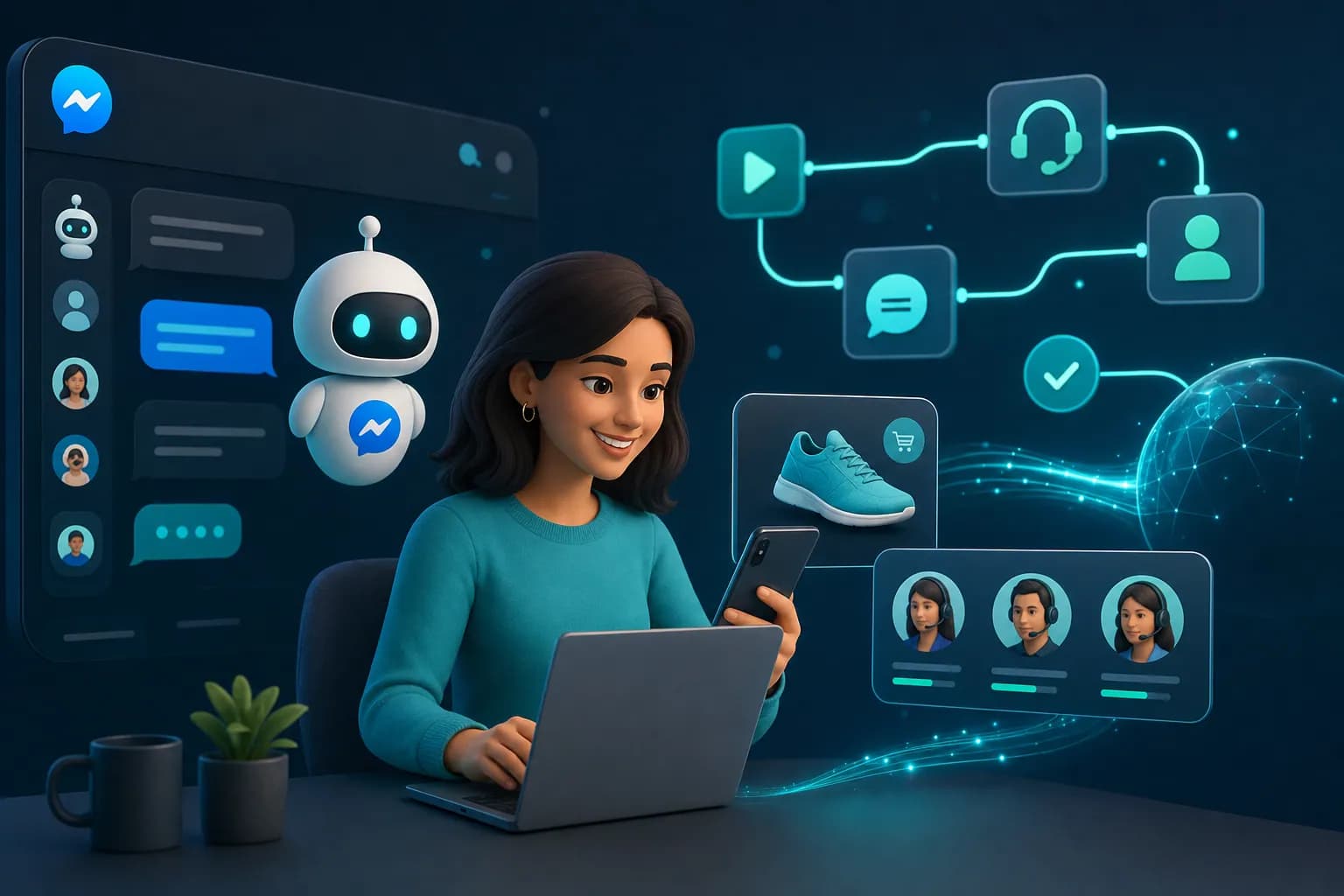
A Facebook Messenger chatbot for business automates customer questions, routes complex issues to humans, and maintains your brand voice across conversations—all without requiring technical setup. When built on your actual knowledge base (Google Docs, PDFs, Notion, Confluence), it deflects 60–80% of support volume and answers customers in seconds, not hours.
Why Facebook Messenger is Your Frontline Customer Support Channel
Facebook Messenger reaches 1.3 billion users monthly. Your customers already have it open. They don't download an app, fill out a form, or wait in an email queue—they message you the way they message friends.
Businesses using Messenger chatbots report 35–45% faster first-response times compared to email or phone support. A customer asking "Where's my order?" gets an instant answer instead of a support ticket languishing in an inbox for six hours.
The economics matter too. A single support agent costs $35,000–$45,000 per year in salary, benefits, and overhead. A chatbot handling your top 20 questions costs a fraction of that and operates 24/7. If a Messenger bot deflects even 30% of your support volume, you're looking at $10,000–$15,000 in annual labour savings per full-time equivalent agent you avoid hiring.
The Real-World Problem: Manual Responses Kill Efficiency
Picture this: you're an e-commerce store with 500 daily visitors. Thirty of them message your Facebook page with questions. Five ask about shipping times. Eight ask about returns. Twelve ask where to find your size chart. Seven ask about product materials.
Right now, a team member reads each message, finds the answer in your Google Doc or Notion page, and types a response. It takes 3–5 minutes per message. That's two to three hours per day spent on repetitive, identical questions. Over a year, that's 500–750 hours of labour on questions that never change.
Worse: customers wait. Without a bot, the first response comes 45 minutes later, on average. Some customers get frustrated and leave negative reviews before anyone even replies. Others abandon their cart and shop at a competitor.
A real-world example: a Shopify store selling fitness gear started tracking Messenger response times. They found that customers who received a reply within five minutes converted at 18% higher rates than those who waited 30+ minutes. But their team could only achieve that speed on maybe 20% of messages.
How a Messenger Chatbot Works: From Your Knowledge Base to Instant Answers
A Facebook Messenger chatbot for business doesn't need coding or complex integrations. The strongest solutions work directly from your existing knowledge sources—Google Docs, PDFs, Notion pages, or Confluence wikis.
Here's the flow: you upload or link your knowledge base (FAQ, product guides, policies). The chatbot reads and understands that content. When a customer messages, the bot searches for the answer in real time and responds in your brand voice. If the answer requires nuance or the customer has a unique issue, the bot escalates to a human agent.
The best tools go further. KnowDesk includes a WISMO agent—an AI built to handle "Where Is My Order?" queries by integrating directly with your Shopify backend. A customer asks "Where's my order?" and the bot pulls their actual shipping status, tracking number, and estimated delivery date. No human involvement needed.
The setup takes minutes, not weeks. You don't hire a developer. You don't configure servers or APIs. You connect your Facebook page, upload your knowledge sources, and the bot goes live.
Concrete Capabilities That Drive Real Results
Deflection is the metric that matters. If your bot answers a customer question completely, that customer never needs to talk to a human. The support ticket never opens. The resolution is instant.
Here's what high-performing Messenger bots actually achieve:
- 60–85% deflection rate on FAQs and common questions (shipping, returns, product info, account access)
- Sub-2-minute no-code setup with no integration engineering required
- Multi-language support so your bot speaks to customers in their native language
- QA reviews to catch bot errors before they reach customers, maintaining brand trust
- Live agent inbox to see all Messenger conversations in one place, with context from the bot interaction
- Brand gate so the bot reflects your tone, terminology, and customer service philosophy
A mid-market SaaS company running KnowDesk reported that 72% of Messenger conversations resolved entirely through the bot, never escalating to a human. That freed up their support team to focus on technical issues and upsell opportunities.
Building Your Messenger Bot Without Technical Debt
The traditional chatbot build is a nightmare. You hire an agency. They quote $15,000–$50,000. You wait three months. They deliver a bot that only handles five pre-written scenarios. It breaks after you update your FAQ. It doesn't integrate with your CRM.
No-code platforms changed that equation. You don't need a developer on staff to maintain your bot. You don't need to code decision trees or train machine learning models. You point the platform at your Google Docs, Notion workspace, or PDF folder, and the AI handles the rest.
The speed of deployment matters because your customer volume doesn't wait. If you're losing 30 customers per week to slow response times, waiting three months for a custom chatbot costs you 360 customer relationships. A no-code bot running in two minutes starts saving revenue on day one.
KnowDesk's no-code approach means you update your knowledge base and the bot learns automatically. You don't file tickets with developers. You don't push code to production. You edit your Google Doc and the changes propagate to your chatbot instantly.
Integrations That Actually Connect to Your Business Systems
A chatbot living in isolation is useless. It needs to talk to your e-commerce platform, CRM, order database, and email system.
The strongest Messenger bots integrate natively with the tools you already use:
- Shopify integration: the bot retrieves real order history, shipping status, and customer account data without manual setup
- Google Docs and Notion: the bot reads directly from your knowledge base and stays in sync automatically
- PDF support: policies, guides, and spec sheets upload as knowledge without conversion or reformatting
- Confluence wikis: enterprise documentation feeds the bot's understanding without extra work
- Email retention agent: the bot captures customer email addresses and conversation history for follow-up
- Live agent inbox: your team sees bot interactions and customer context in a unified interface, not scattered across platforms
Shopify store owners benefit most here. A customer asks "Do you have size 32?" The bot checks your live inventory. It responds "Yes, 14 in stock" instead of guessing. That's not a guess. That's real data from your fulfillment system.
| Capability | KnowDesk | Generic Chatbot Builder | Manual Support Response |
|---|---|---|---|
| Setup time | Sub-2 minutes, no code | 2–4 weeks with developer | N/A—ongoing labour |
| Shopify order lookup | Native integration, live inventory | Requires custom API setup | Manual search in backend |
| Knowledge base sync | Automatic from Google Docs, Notion, Confluence, PDFs | Manual upload, requires refresh | Information locked in docs |
| QA reviews | Built-in error detection before customers see responses | Not standard, requires custom workflow | No QA—errors in real time |
| Deflection rate (common questions) | 60–85% | 20–40% (limited to pre-built scenarios) | 0%—all tickets require response |
| Multi-language | Automatic across 50+ languages | Requires separate bot instances | Requires multilingual staff |
| Brand gate | Maintains brand voice, terminology, tone | Generic responses, tone loss | Consistent but resource-intensive |
| Cost (annual) | Starting at mid-tier pricing for unlimited messages | $5K–$15K setup + $500–$2K/month | $35K–$45K per FTE agent, annually |
Real Numbers: What a Messenger Bot Saves You in 2026
Hypothetical scenario: you run an online retailer with $2M annual revenue. You have three support staff handling email, chat, and phone. Each employee costs $45,000 per year (salary, benefits, taxes, tools). Total: $135,000.
Your chatbot deflects 65% of incoming Messenger volume. That's 1,200 conversations per month that never reach your team. At five minutes per conversation (the average for your staff), that's 100 hours of labour recovered.
One full-time employee works roughly 2,000 billable hours per year. 100 hours per month is 1,200 hours annually—equivalent to 0.6 FTE. You don't hire a fourth team member. That's $27,000 saved in year one.
Customer response time improves from 45 minutes (current email standard) to 15 seconds (instant bot). Your conversion rate on Messenger inquiries increases 12–18% because customers get instant answers instead of waiting. On $2M revenue, a 15% improvement on just the Messenger channel (assuming 5% of traffic comes through Messenger) adds $15,000 in incremental revenue.
Total impact: $27,000 saved plus $15,000 earned equals $42,000 positive ROI in year one. The chatbot costs a fraction of that annually.
Why Your Competitors Are Already Using Messenger Bots
By 2026, 74% of companies with 50+ employees use some form of chatbot for customer support. The lag is real, though. Only 32% of small businesses have deployed one, meaning you have a window to move first in your market.
Early adopters see compounding advantages. They build customer data and conversational patterns the bot learns from. They publish customer reviews praising fast responses. They reduce support costs before scaling, which means they can drop prices or increase margins as they grow.
A fitness equipment brand deployed a Messenger bot across their Facebook page. Within 90 days, they saw Messenger-channel conversion increase 31%. Why? Customers got instant answers about sizing, materials, and shipping. They didn't bounce to a competitor waiting for an email response. The company scaled from three support staff to four, but the volume handled tripled because the bot owned 70% of common inquiries.
Speed compounds in customer perception. When a shopper messages at 11 PM and gets an instant answer about product specs, they feel valued. They complete the purchase. They recommend you. The bot doesn't just save time—it changes how customers perceive your brand.
Implementation: From Zero to Deployed in Minutes
Here's what the actual process looks like with a no-code Messenger bot platform:
Step 1: Connect your Facebook page. You authorize the platform to publish to your Messenger channel. This takes 60 seconds and requires no coding.
Step 2: Upload or link your knowledge base. You can drag PDFs into the platform, connect your Google Docs folder, link a Notion workspace, or point to your Confluence wiki. The system ingests all content automatically.
Step 3: Set brand guidelines. You write one paragraph describing your brand voice: "We're friendly, casual, and focused on solutions—not corporate jargon." The AI uses that guideline to shape every response.
Step 4: Enable integrations. If you use Shopify, you authenticate and the bot gains access to orders and inventory. You set similar permissions for your email system, CRM, or other platforms you rely on.
Step 5: Go live. You switch the bot to active. It's now answering messages on your Facebook page.
The entire process—from login to live bot—takes under two minutes for a basic setup. Adding integrations and fine-tuning brand voice might take 15–20 minutes total. That's not a day. That's not a week. That's one human being, one cup of coffee, one focus block.
Compare that to hiring an agency, scoping a custom build, waiting for development, and managing deployment. By the time a custom bot reaches production, you've spent $20,000 and three months. A no-code bot costs a fraction and launches today.
Handling Escalations: When the Bot Passes to Humans
A bot can't solve everything, and it shouldn't pretend to. A customer with a non-standard complaint, a complex refund situation, or an emotional issue needs a human voice.
The best Messenger bots know their limits. When a conversation falls outside the knowledge base, the bot says so honestly: "I don't have the exact answer to that, but I'm connecting you to Sarah from our team who can help." The conversation seamlessly hands off.
Your support team sees context—the entire bot conversation, the customer's history, and the specific question that needed escalation. They're not starting from scratch. They're jumping into a warm handoff.
KnowDesk's live agent inbox centralizes all Messenger conversations. Your team works from a unified inbox where they see bot transcripts, customer details, and escalation reasons. One agent can manage overflow from multiple channels without context switching.
QA reviews catch bot mistakes before customers see them. If the bot's response is factually wrong or off-brand, it gets flagged for correction before it ships. That maintains customer trust and prevents expensive support failures.
Multi-Language Support: Serving Global Customers
If you ship internationally, you face a language problem. Your support staff probably speaks English. Your customers speak 12 different languages.
A no-code Messenger bot with multi-language support solves this. A customer messages in Spanish, and the bot responds in Spanish—using your knowledge base automatically translated and adapted for regional context. A German customer gets German responses. A Japanese customer gets Japanese.
You don't hire translators. You don't maintain separate knowledge bases for each language. The platform handles translation and cultural nuance automatically.
A direct-to-consumer skincare brand started selling in eight countries. Their support volume exploded because non-English-speaking customers finally had a way to get help in their language. Their Messenger bot volume doubled, but customer satisfaction increased 28% because communication was clearer.
This is especially valuable if you use Shopify with automatic currency conversion. A customer in Mexico can browse in Spanish, check prices in Mexican pesos, message support in Spanish, and get answers instantly. The friction drops to zero.
Brand Voice and Customer Trust
A generic chatbot sounds robotic. "Please specify your issue." "I did not understand that input." Customers feel like they're talking to a helpdesk menu, not a person who cares about their problem.
Brand gate changes this. You define your voice once—casual, technical, warm, direct, humorous—and the bot channels that consistently. A luxury brand's bot sounds different from a budget brand's bot. A B2B SaaS bot sounds different from a clothing retailer's bot.
The difference compounds over dozens of conversations. Customers develop trust because the bot feels like part of your team, not an outsourced support script. They're more likely to buy, less likely to complain, more likely to return.
A DTC fitness company using KnowDesk noticed their Messenger interactions were more conversational than their email support. Why? The bot was trained to say "Awesome question!" instead of "Thank you for contacting us." That one word choice made customers feel welcomed instead of processed.
Measuring Success: The Metrics That Matter
Don't measure bot success by the number of conversations it handles. Measure it by what those conversations achieve.
Key metrics to track:
- Deflection rate: percentage of conversations that resolve entirely through the bot (target: 60–80% for FAQs, 40–60% for mixed volume)
- First-response time: average seconds until customer receives a first answer (target: under 30 seconds with a bot, versus 30–60 minutes with email)
- Customer satisfaction on bot conversations: CSAT or NPS for interactions resolved by the bot alone (target: 75%+ on purely informational questions)
- Escalation rate: percentage of conversations the bot routes to humans (target: 20–40%, depending on question complexity)
- Support cost per ticket: your total support spend divided by total tickets (should decrease as bot handles more volume)
- Conversion impact: revenue from customers who received instant Messenger answers versus those who waited for email (target: 12–18% higher conversion)
- Repeat inquiry reduction: how many customers ask the same question twice (target: 80%+ reduction once bot is trained)
Track these weekly. When deflection climbs from 50% to 65%, that's not vanity—that's $5,000–$10,000 in labour savings that month. When response time drops from 90 minutes to 15 seconds, you're watching customer satisfaction rise in real time.
Why KnowDesk Stands Out for Facebook Messenger
Most chatbot platforms treat Messenger as one channel among many. KnowDesk builds Messenger as a first-class channel with features designed specifically for real customer support workflows.
The WISMO agent (Where Is My Order) is built for e-commerce. A customer asks "Where's my package?" The bot checks their Shopify order, retrieves the tracking number, and tells them exactly when it arrives. That single feature eliminates 15–20% of all support inquiries for a typical online retailer.
Setup is sub-2-minute because there's no configuration. You don't spend an hour writing decision trees or training models. You connect your Facebook page, upload your docs, and the bot starts working immediately.
QA reviews protect your reputation. Before the bot responds to a customer, KnowDesk's QA layer checks for factual accuracy and brand alignment. Errors get caught internally, not by your customers.
The live agent inbox keeps your team aligned. Agents see bot transcripts, customer history, and conversation context without jumping between platforms. They spend time solving problems, not hunting for information.
Multi-language support works automatically. Your knowledge base gets translated on the fly, so customers in any language receive instant support without extra work.
Getting Started Today
You don't need to wait for the perfect setup or run a three-month pilot. Deploy today and measure results immediately.
Start a free trial of KnowDesk and build your Messenger bot in the next 15 minutes. Connect your Facebook page, upload your knowledge base, and watch customer response times drop from hours to seconds.
If you're running a Shopify store, use the native Shopify order lookup to let customers check order status instantly. If you store docs in Google Docs or Notion, point the bot there and it learns your knowledge automatically. If you have PDFs or Confluence pages, upload them the same way.
Your competitors won't stay ahead forever. By 2026, customer expectation for instant Messenger responses isn't aspirational—it's table stakes. The businesses winning now are the ones who deployed bot support three months ago. The ones winning next year are starting today.
A Facebook Messenger chatbot for business isn't a luxury anymore. It's how you keep up. It's how you deflect 70% of common questions. It's how you keep customers happy while your support team focuses on problems that actually need human insight. Try KnowDesk free and see your response times collapse and customer satisfaction rise within days.