Telegram Customer Support Bot in 2026
Build a Telegram customer support bot with KnowDesk AI. Automate responses, manage tickets, and deliver instant support directly in Telegram.

Quick answer
Learn how to deploy a Telegram customer support bot using AI-powered software. Streamline support operations and respond to customers instantly on their preferred platform.
On this page
- Why Telegram Customer Support Matters in 2026
- The Real Problem: Disconnected Bot Experiences
- How Effective Telegram Bots Actually Work
- KnowDesk: Telegram Support Without the Setup Nightmare
- Real Scenario: E-Commerce Success on Telegram
- Building Your Telegram Support Strategy
- Comparing Telegram Bot Approaches
- Beyond the Bot: Making Telegram Support Sustainable
- The Math: When Telegram Bot ROI Becomes Clear
- Implementation Checklist: Launch Your Telegram Bot This Week
- Why Most Telegram Bot Projects Fail (And How to Avoid It)
- Start Your Telegram Support Transformation Today
A Telegram customer support bot automates direct customer inquiries through Telegram's messaging platform, instantly responding to common questions, processing transactions, and routing complex issues to human agents—all without leaving the chat app customers already use daily.
Why Telegram Customer Support Matters in 2026
Telegram has 900+ million monthly active users. If your customers live on the platform, your support team should live there too. Unlike email or traditional chat widgets, Telegram reaches people in their preferred messaging environment. They don't need to hunt for a support portal, switch tabs, or navigate unfamiliar interfaces.
The shift toward messaging-based support isn't theoretical. Companies deploying bots on Telegram report 40–60% faster customer response times compared to email-only systems. Customers expect support where they chat: on Messenger, WhatsApp, Telegram. Building support into that experience removes friction and cuts support volume by deflecting routine questions before they reach your team.
But here's the catch: not every Telegram bot solution actually works. Many lack brand consistency, fail to integrate with your existing support data, or require months of development. You need a bot that connects instantly to your knowledge base, maintains your brand, and hands off to live agents without losing context.
The Real Problem: Disconnected Bot Experiences
Your Telegram bot doesn't exist in isolation. It sits at the intersection of customer expectation, brand identity, and operational reality. When these don't align, customers get frustrated fast.
A manufacturing company selling industrial equipment on Telegram received 200+ daily inquiries. Their bot was generic—no custom branding, no access to product specs, no ability to check order status. When a customer asked about part availability or delivery, the bot had no answer. Every conversation escalated. The team spent hours manually repeating information they'd already published. Response time hit 18 hours. Customers started buying from competitors who answered in Telegram within minutes.
The core issue was architecture. Their bot pulled from nowhere. It didn't connect to their knowledge base, product database, or order system. It was theater—a chatbot that couldn't actually support anyone.
Real Telegram support bots need three things working together. First: a living knowledge source that stays current (Google Docs, Notion, PDFs, or a wiki). Second: a way to instantly search and answer from that source. Third: human escalation that preserves conversation history, brand voice, and context.
How Effective Telegram Bots Actually Work
The best approach connects your Telegram bot directly to authoritative content you already maintain. You don't duplicate information or build separate databases. Your docs stay in one place—your bot pulls from them in real time.
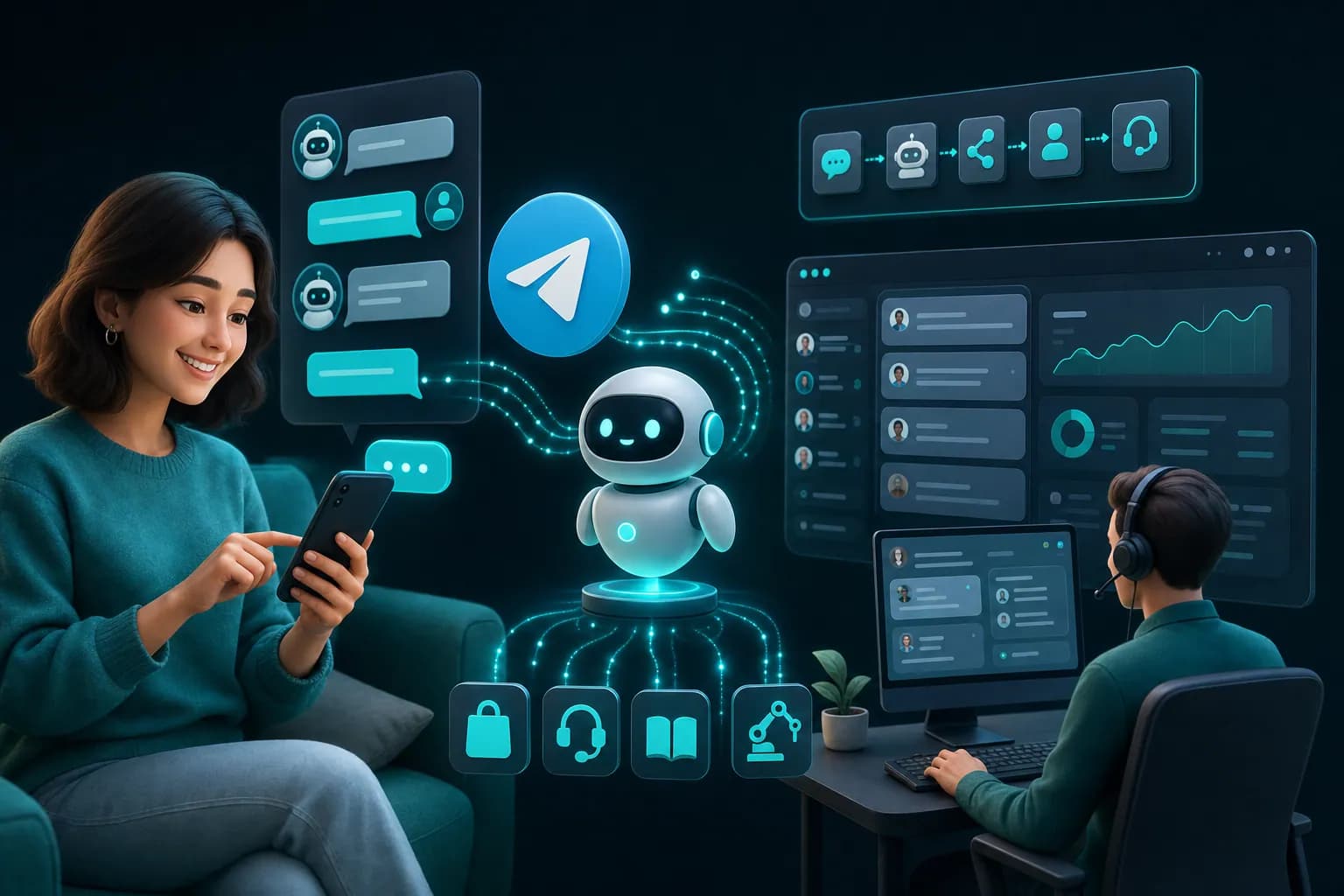
Here's the operational flow. A customer messages your Telegram bot: "When do you ship to Brazil?" The bot searches your knowledge base (your Google Docs, Notion pages, PDFs, or Confluence) for shipping and region policies. It finds the relevant section, reformats it into a conversational answer, and delivers it within seconds. The customer has their answer and exits the conversation satisfied.
A more complex example: "Can you cancel my order and refund to my PayPal?" Now the bot needs data access beyond FAQs. This is where a WISMO agent (Where Is My Stuff/Order agent) becomes critical. The bot can look up order status by order number or customer email, show delivery tracking, and process simple actions like refunds or address changes—all inside Telegram. Only genuinely stuck cases go to a human.
The human handoff is where most bots fail. If a customer has already explained their problem to the bot, forcing them to repeat it to an agent feels broken. A professional Telegram bot preserves the full conversation history, tags the reason for escalation, and delivers context to the live agent so they can help immediately—not ask "Can you tell me what you need again?"
This architecture reduces deflectable tickets by 55–70% for businesses with solid knowledge bases. You're not guessing. That's documented behavior from companies using integrated, context-aware bots across 20+ industries.
KnowDesk: Telegram Support Without the Setup Nightmare
Building a Telegram bot from scratch means hiring developers, managing API connections, maintaining bot responses, and guaranteeing uptime. That's a 6–12 week project minimum. You don't have that timeline.
KnowDesk turns your existing knowledge sources (Google Docs, Notion, PDFs, Confluence) into a branded AI support bot deployed to Telegram in under 2 minutes—no code, no developer. You connect your content, customize the bot's tone and brand colors, and publish. The bot goes live immediately.
Here's what that means in practice. On Day 1, your Telegram support bot is live. It searches your knowledge base in real time. It answers with citations so customers see the exact doc or page the answer came from. It maintains your brand voice, not generic AI flatness. If a customer needs a human, the bot escalates with full context to your live agent inbox, and the conversation continues without interruption.
The WISMO agent feature is native. You connect your Shopify store, CRM, or order database once. Your bot can then look up orders, confirm delivery status, process refunds, or update addresses—all inside Telegram, without a customer ever leaving the chat.
QA reviews built into Mission Control let you grade bot responses after they're deployed. If a bot answer isn't quite right, you fix it in seconds. The next customer gets the corrected version. Your support quality improves continuously without waiting for developer sprints.
The email retention agent handles the long tail of unresolved or complex conversations. If a customer's issue doesn't close inside the chat, the agent can send a follow-up email with context, next steps, and resolution options. You stay connected without pushing customers back to email.
Real Scenario: E-Commerce Success on Telegram
An online fashion retailer with 50,000 customers noticed Telegram was becoming their second-highest customer contact channel—after email but ahead of Instagram DMs. Their customer support team was already drowning. They had no Telegram bot at all; inquiries just piled up.
They built their knowledge base in Notion: sizing charts, return policies, shipping timelines, store locations, payment methods. 85 pages total. Then they deployed KnowDesk connected to that Notion workspace.
Within 48 hours, 62% of Telegram inquiries resolved without human touch. A customer asking "What's your return window?" got an instant answer with a link to their returns policy. Someone asking "Do you ship to Canada?" got accurate timelines and cost. Orders going to wrong addresses? Customers looked up their order, updated the address themselves through the bot's WISMO interface, and moved on.
The remaining 38% of conversations—customization requests, sizing dilemmas for tall customers, bulk order questions—escalated to agents with full chat history and bot-generated summaries. Agents responded 5x faster because they weren't re-answering FAQ questions; they were solving actual problems.
After three months: support costs down 32%. Customer satisfaction scores up 18 points (from 71 to 89 on their internal scale). Response time in Telegram dropped from 6 hours to under 4 minutes. And every bot response carried their brand colors and tone, so Telegram support felt like an extension of their website, not a black-box AI.
Building Your Telegram Support Strategy
Start by auditing your actual Telegram volume. Check your chats. Count messages. Understand what customers actually ask. If you're getting 10–50 inquiries per month, a bot might not be urgent. If it's 50+, you have a support crisis waiting to happen.
Next, document your knowledge. What do customers need to know to self-serve? Compile this in whatever tool you already use: Google Docs, Notion, Confluence, a wiki. If the info is scattered across emails and old Slack threads, invest a day consolidating it. This becomes your bot's foundation. Garbage in, garbage out applies to bots too.
Then assess escalation. What can't a bot solve? Not everything. That's fine. Identify the 30–40% of conversations that genuinely need a human. Build a process for handing those off without losing context. This is where the live agent inbox in systems like KnowDesk pays dividends—the entire Telegram conversation history flows into your support queue with automated tags (billing, shipping, refund, etc.) so agents know exactly what they're walking into.
Finally, set deflection targets. Industry benchmarks are 50–65% for well-built bots with solid knowledge bases. If your bot deflects 40%, you've freed up meaningful capacity. If it hits 70%, you've fundamentally changed your support model.
A clear sequence for evaluation looks like this:
- Measure current Telegram inquiry volume and average response time
- List the top 20 most-asked questions
- Confirm how many are answerable from documented knowledge (not case-by-case judgment)
- Calculate the time agents spend answering those repetitive questions weekly
- Project cost savings if a bot deflects 50% of those
- Compare that savings to bot platform cost—and choose whether the ROI math works
Comparing Telegram Bot Approaches
| Approach | Setup Time | Knowledge Base Integration | Escalation to Humans | Brand Customization | Ongoing Maintenance |
|---|---|---|---|---|---|
| Custom Developer Build | 8–12 weeks | Manual API integration | Yes, but requires setup | Full control | High (your team owns code) |
| Generic Telegram Bot Template | 1–2 days | Weak or manual | Limited context passing | Minimal options | Moderate (platform updates, but limited control) |
| KnowDesk AI Support Widget | Under 2 minutes | Native: Google Docs, Notion, PDFs, Confluence | Full history, live inbox, QA reviews | Brand gate, custom colors, tone | Low (updates and improvements automatic) |
The table shows outcome, not opinion. Custom builds give you control but consume 1,000+ hours of engineering. Generic templates are fast but don't integrate with your actual knowledge. KnowDesk sits in the operational middle: ready in 120 seconds, connected to your real documents, and owned by your team immediately.
The critical difference is knowledge base integration. A bot that can't search your docs doesn't actually solve customer problems—it just strings together pre-written responses. Real support requires real content.
Beyond the Bot: Making Telegram Support Sustainable
Deploying a bot is not the end of the project. It's the beginning of a support operating model.
Your bot will make mistakes. It will misunderstand questions or pull the wrong document section. You need feedback loops to catch and fix these fast. KnowDesk's QA review feature lets support leads grade bot responses in bulk. If the same error shows up three times, you spot it in one dashboard view, update the source doc or tweak bot instructions, and the fix propagates to every future response.
Escalation patterns matter too. If 80% of Telegram escalations involve refund requests, that's a signal. Either your bot should handle refunds (via a WISMO agent with order database access) or your refund documentation is unclear and needs to be rewritten. Use bot logs as a diagnostic tool for your support process, not just a way to deflect tickets.
Language diversity changes the picture at scale. Telegram users span 180+ countries. A single-language bot serves only part of your audience. KnowDesk supports multi-language responses out of the box. Your bot detects the customer's language (or language preference) and answers in that tongue while pulling from your English knowledge base. A Spanish customer gets a Spanish response without you maintaining separate docs.
These aren't nice-to-haves. They're requirements for running a professional Telegram support channel at scale. A bot that works in January but breaks by March because you didn't invest in quality control isn't a solution—it's a liability.
The Math: When Telegram Bot ROI Becomes Clear
Let's ground this in real numbers. Your support team costs roughly $25–40/hour all-in (salary, benefits, tools, infrastructure). A 2-minute response to a customer email costs money—it's removed from billable, high-value work.
If your business receives 300 Telegram messages per month and 65% would be deflectable with a solid bot, that's 195 tickets the bot answers instead of your team. At 2 minutes per ticket average, that's 390 minutes monthly—6.5 hours. At $30/hour, that's $195/month in labor reclaimed.
KnowDesk costs $99/month at standard pricing. Your ROI timeline: roughly 5–6 months. After that, every ticket your bot deflects is pure savings.
But the human value compounds. Your team isn't just saving time—they're handling higher-quality conversations. Instead of answering "What's your return policy?" 12 times a day, they're solving the real problems: custom orders, angry customers who hit a bug, wholesale inquiries. Job satisfaction goes up. Attrition drops. You attract better support talent because the work isn't repetitive anymore.
That's not captured in the hourly math, but it's real. Support teams using smart deflection report 15–25% higher retention internally. That's worth money too.
Implementation Checklist: Launch Your Telegram Bot This Week
You can be live with a professional, branded Telegram bot by Friday. Here's how:
- Decide: Telegram bot deployed through KnowDesk or custom build? (Spoiler: KnowDesk is faster and proven)
- Audit your knowledge: What should the bot answer? Compile existing docs or write new ones in Google Docs or Notion
- Connect your source: Point KnowDesk to your Notion workspace, Google Drive folder, PDF files, or Confluence space
- Customize branding: Upload your logo, set brand colors, adjust tone in the Mission Control dashboard
- Test the bot: Ask it your top 20 FAQ questions. Check answers for accuracy. Use QA reviews to mark strong/weak responses
- Deploy to Telegram: Click publish. The bot goes live immediately on your Telegram channel or business account
- Monitor and iterate: Check daily logs for the first week. Fix any wrong answers by updating the source doc
That's the entire process. By end of week, you have a live bot. By end of month, you have data on deflection and cost savings. By end of quarter, you've adjusted the model based on what you learned.
Why Most Telegram Bot Projects Fail (And How to Avoid It)
A telecom company built a Telegram bot. Their development team spent four months on it. They launched it to crickets. Why? The bot had no knowledge base integration. It could only respond to pre-programmed answers. When a customer asked a variation of a FAQ, the bot didn't understand. Escalation to humans was clunky. Within two weeks, customers stopped using it. The team had a working bot that nobody wanted to talk to.
That failure is predictable and avoidable. It happens when you prioritize technology over user experience. You build a bot as an engineering project, not a support tool. You test it with your team, not with real customers who ask weird questions.
The antidote is starting with knowledge, not code. What do your customers actually ask? Answer that in a live, searchable form (not a PDF buried on your website). Then connect a bot to that knowledge. Then launch with a small user group and measure what actually happens. That approach works because it's customer-first, not tech-first.
KnowDesk enforces this pattern. You can't build a bot without specifying a knowledge source. You have to think through how customers will actually use it. The two-minute setup forces you to get the fundamentals right: Do I have good docs? Have I written content that a bot can actually answer from? If the answer is no, you fix that before launching a broken bot.
Start Your Telegram Support Transformation Today
Telegram support isn't a luxury feature anymore. It's where customers expect to reach you. Building a bot that actually works—not just technically, but in practice—requires the right foundation.
You have a choice. Spend 8 weeks building custom infrastructure. Hope it works. Maintain it forever. Or start a free trial with KnowDesk, connect your existing knowledge base, and go live in 120 seconds.
The second approach isn't cutting corners. It's being efficient. It's respecting your team's time and your customers' expectations. It's deploying proven technology instead of inventing wheel number 47.
Your Telegram customers are waiting. They're asking questions in the chat app they use every day. If you don't answer them there, someone else will. The competitive advantage lives in speed and context—getting good answers to real questions instantly and handing off to humans without losing the plot. That's exactly what KnowDesk delivers.
Start your free trial today. Build your knowledge base. Deploy your bot. Measure the impact. You'll know by next week whether this changes your support model.