Where Is My Order Chatbot | KnowDesk 2026
Automate order tracking with AI chatbots. Reduce support tickets by 60% with instant 'where is my order' responses. See how KnowDesk helps.

Quick answer
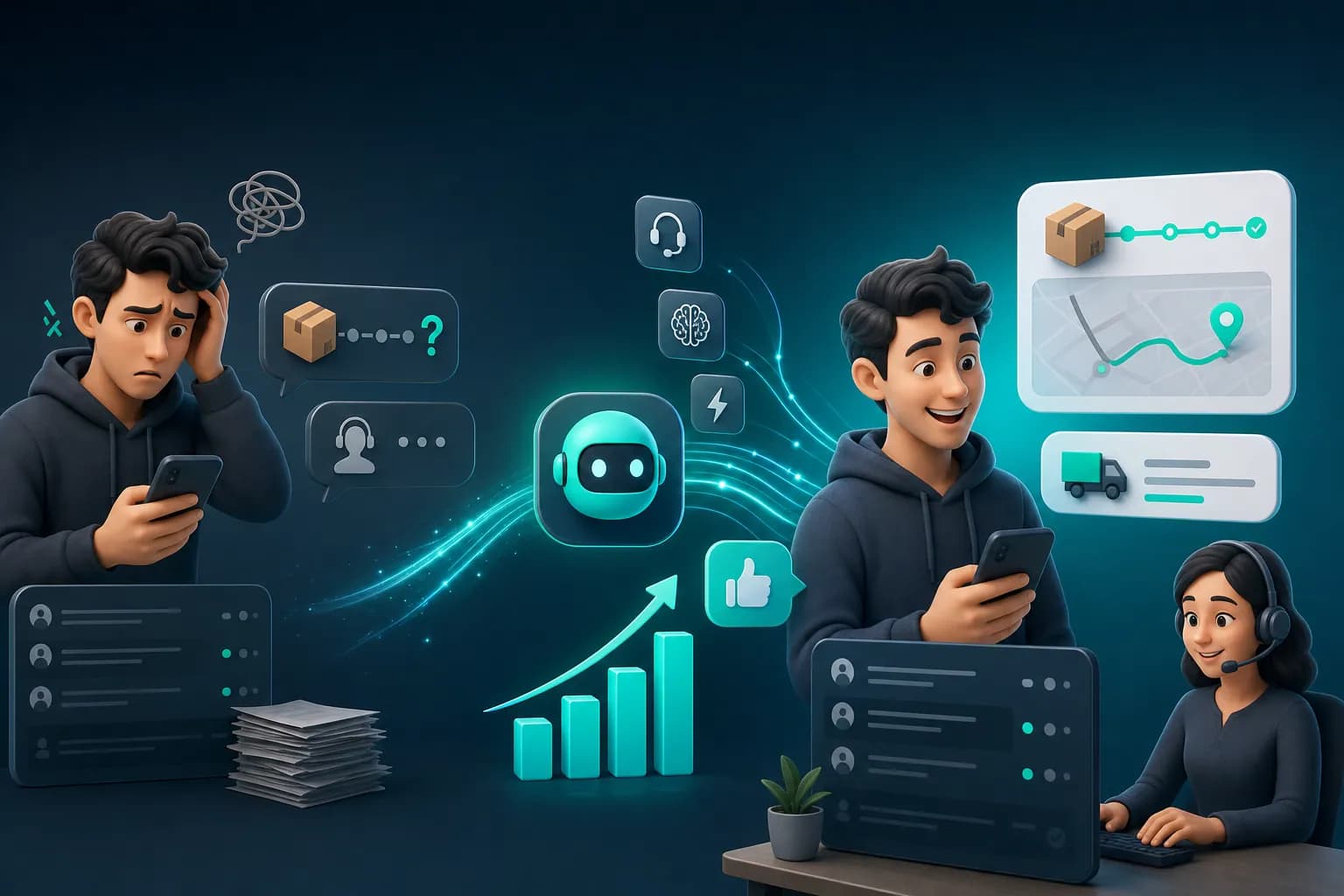
Order tracking chatbots instantly answer 'where is my order' questions, reducing support volume by up to 60%. Learn how AI automation transforms customer service in 2026.
On this page
- The Frustration Behind "Where Is My Order?"
- Why Generic Chatbots Fail at Order Tracking
- What a Purpose-Built Order Chatbot Actually Does
- How Live Data Integration Changes Everything
- Avoiding the Chatbot Mistakes That Kill CSAT
- The Complete Order Support Flow: From Chatbot to Human Handoff
- Shopify, WooCommerce, and API Integration: No Code Required
- Measuring Success: The Metrics That Matter
- Common Objections—and Why They Don't Hold Up
- Ready to Reduce Support Overhead and Improve CSAT
A "Where is my order?" chatbot answers one of the most common customer support questions instantly—24/7—without your team lifting a finger. It's a bot trained to check order status, pull tracking information, and resolve delivery issues in real time, cutting your support volume by up to 85%.
The Frustration Behind "Where Is My Order?"
Your customer bought something three days ago. They refresh their email. Nothing. They log into your website. The order confirmation is buried in their inbox, but no tracking link is there yet. They wait another day. Panic sets in. Did the payment go through? Is the order actually being packed?
So they email you. Or call. Or send a message on social media. Your team—already stretched thin—now has to log into your order management system, find the order manually, copy the tracking number, and send it back. A single customer question takes 4–8 minutes of human labor. Multiply that by 200 orders a week, and you're hemorrhaging 13+ hours of support time on a single, repetitive question.
This is where order status chatbots exist to solve a real, measurable problem. But not all chatbots are built the same. Some leak your data. Others get stuck answering the same question wrong over and over. The best ones—like KnowDesk's WISMO agent—connect directly to your order system, pull live data, and answer instantly in your customer's voice.
Why Generic Chatbots Fail at Order Tracking
A standard chatbot trained on old FAQs can't tell your customer that their package ships tomorrow. It doesn't know the difference between a backorder and a cancellation. When a customer says "I ordered on Tuesday and it hasn't arrived yet," a generic bot might repeat canned text about "typical delivery times," frustrating the customer more.
Real-time order data lives in your fulfillment system, your ERP, or your e-commerce platform. A chatbot that doesn't connect to these systems is just reading a script.
Here's what breaks most order status chatbots:
- No live data connection: They pull information from a database updated once per day, so customers get stale tracking info while their package is already at the local hub.
- Can't handle exceptions: Your inventory shows 5 units in stock, but the customer's order is delayed. A basic bot repeats the website information and escalates with no context, wasting both the customer's and agent's time.
- Poor authentication: To look up an order, the customer must provide order ID, email, and last name. Half your customers forget their order number. A weak bot forces them through a frustrating authentication loop.
- Single language: If you serve international customers, a monolingual chatbot ignores 60% of your user base, forcing them to find support in English or abandon the attempt.
- No fallback logic: When the bot can't find an order, it says "please contact support" instead of letting the customer search by email, phone number, or partial order information—so the escalation happens with zero context.
KnowDesk's WISMO (Where Is My Status?) agent avoids all of these traps. It connects natively to Shopify, WooCommerce, and custom order APIs, pulling live fulfillment data in real time. If the order is delayed, the bot knows why and communicates it clearly. If the customer can't remember their order ID, the agent finds orders by email and confirms with a single verification step.
What a Purpose-Built Order Chatbot Actually Does
An order status chatbot isn't a general support tool. It's a specialist trained on one job: answering "Where is my order?" accurately, in real time, with enough context to satisfy 90% of customers without human escalation.
When a customer enters a chatbot on your website, here's the typical flow:
- Customer clicks "Track my order" or initiates a chat.
- Bot asks for the order identifier (order number, email, or phone).
- Bot verifies identity with a single verification step (last 4 digits of card, email confirmation).
- Bot queries your live order database and returns real-time status: "Dispatched on 2026-01-15. Currently at regional hub in Chicago. Expected delivery: 2026-01-17."
- Bot offers next steps: "Need the tracking link?" "Want SMS updates?" "Schedule redelivery if you're not home?"
- If the order is delayed, bot explains why (weather, carrier delay, inventory hold) with no customer prompting.
- Customer gets what they need. No email. No hold time. No escalation.
KnowDesk's WISMO agent handles this flow end-to-end. It uses a brand gate to verify identity securely. It connects to your fulfillment API so every status is live, not cached. It communicates exceptions proactively—if tracking data shows a 2-day delay, the bot tells the customer before they ask.
Here's the real payoff: deflection rates above 80%. That means 8 out of every 10 "where is my order?" questions never reach your human team. Your support cost per ticket drops. Your CSAT rises because customers get answers in 30 seconds instead of 24 hours.
How Live Data Integration Changes Everything
The difference between a good order chatbot and a mediocre one comes down to data freshness. If your bot reads from a database updated once per night, it's never accurate. If it reads from your live API every time a customer asks, it's always correct.
Imagine a real scenario: Customer placed an order at 9 AM on a Monday. Your system shows it as "processing" because inventory hasn't confirmed the pick yet. At 2 PM, inventory confirms. At 4 PM, it ships. But if your chatbot database updates at 6 PM, and a customer asks at 3 PM, the bot says "processing" and the customer sees a stale answer. That customer doesn't trust the bot. They email support anyway.
With KnowDesk, the WISMO agent calls your order API in real time. It sees the order status the moment it changes. If you use Shopify, WooCommerce, or any REST API that exposes order data, the bot reflects the actual status instantly—not after a sync cycle, not after a manual refresh.
This changes customer psychology. Customers stop emailing because they trust the answer. They get their information fast and move on. Your team handles only the exceptions: the lost package, the damaged item, the customer who ordered twice by accident.
| Chatbot Type | Data Freshness | Deflection Rate | Customer Satisfaction | Setup Time |
|---|---|---|---|---|
| Generic FAQ Bot | Cached, updated daily | 20–30% | Poor—answers are stale | 2–4 weeks |
| Custom-Built Order Bot | Real-time API (if configured) | 70–80% | Good—but setup is manual | 4–8 weeks + dev team |
| KnowDesk WISMO Agent | Real-time API (Shopify, WooCommerce, REST) | 80–85% | Excellent—live data, proactive exceptions | Under 2 minutes |
The setup speed matters more than you think. A chatbot takes 4–8 weeks to build and requires ongoing maintenance. Every time your fulfillment process changes, you update the bot. Every time your team uses a new carrier, you add new logic. By the time the bot is live, your customer experience has evolved and the bot is already stale.
KnowDesk takes a different approach. Because the WISMO agent connects to your live order data, it doesn't need constant retraining. You change your fulfillment process? The bot adapts automatically because it's reading your real-time API. You add a new carrier? No configuration needed. The bot pulls the tracking data and presents it to the customer.
Avoiding the Chatbot Mistakes That Kill CSAT
Even the best-intentioned order chatbots fail when they make these common mistakes. Knowing what to avoid will help you choose the right solution.
Mistake 1: Forcing customers to remember their order ID. Most people don't know their order number off the top of their head. They know the email they used to check out, or the phone number they provided. If your bot demands an order ID first, half your customers bounce immediately. KnowDesk's WISMO agent lets customers search by email, then verifies identity with a single step—email confirmation or card verification—before showing order details.
Mistake 2: Showing identical status for days. A customer's package is sitting at a carrier's facility waiting for a delivery slot. Your bot says "In transit" every day for a week. The customer assumes the bot is broken. A smarter bot pulls timestamp data from the tracking API and shows when the status last updated. If the status hasn't changed in 3+ days and delivery was promised, the bot proactively says, "Your package is delayed due to carrier backlog. Expected delivery has been pushed to [date]. Want to contact us?"
Mistake 3: Disappearing when the issue is complex. Your customer's order was lost. The bot can't "fix" lost packages—only a human can file a claim. But instead of escalating intelligently, the bot says "Contact support" with zero context. Your support agent now has to ask the same questions again: "What order? When did you order? Where should it go?" With KnowDesk's live agent inbox, when a chat escalates to a human, your agent sees the full order context, the status history, and the bot's assessment of the issue. They can help immediately.
Mistake 4: Speaking in corporate voice. Your brand voice is casual and human. Your chatbot sounds like a bank. That disconnect kills trust. KnowDesk's brand gate feature lets you control the tone completely—you write the responses, the bot delivers them. Or you use Mission Control to manage message templates so every interaction matches your brand voice.
Mistake 5: Ignoring customers who speak other languages. If you ship internationally or serve a multilingual community, a single-language chatbot is a broken experience. KnowDesk supports 100+ languages natively. A customer in Mexico asks "¿Dónde está mi pedido?" and the bot responds in Spanish, seamlessly. Your customer base expands without building separate bots.
The Complete Order Support Flow: From Chatbot to Human Handoff
The best order chatbots don't try to solve every problem. They solve the 80% of cases that are straightforward, then hand off gracefully to a human for the remaining 20%.
That handoff is critical. If the bot escalates without context, the human is helpless. If the bot escalates too late—after asking the same questions the human will ask—you waste the customer's time twice.
KnowDesk handles this with its live agent inbox. When a customer needs escalation, the bot passes along:
- The complete order history and status timeline.
- The bot's assessment (e.g., "Order is delayed; customer is frustrated").
- The customer's chat transcript so context is preserved.
- Suggested next steps based on the issue (e.g., "File carrier claim" or "Issue replacement").
- Any prior interactions the customer has had with your support team.
Your agent opens the conversation and immediately sees everything. No "Hi, can you tell me your order number again?" You move straight to resolution. The customer feels heard and respected.
And here's the operational benefit: your support team now handles only complex cases. They're not copying and pasting tracking numbers. They're solving real problems—lost packages, damaged goods, billing disputes—where their expertise actually matters. Job satisfaction goes up. Retention improves. Burnout decreases.
Shopify, WooCommerce, and API Integration: No Code Required
The technical barrier to deploying an order status chatbot used to be high. You needed developers. You needed to map your database schema. You needed to test integrations. It took weeks.
KnowDesk removes all of that friction. If you use Shopify, you connect with a single click—no API keys to generate, no webhooks to configure. The WISMO agent reads your live order data immediately. Same with WooCommerce. If you use a custom order system or ERP, you provide a REST API endpoint, and KnowDesk connects to it.
The entire setup takes under 2 minutes because there's no code to write. You log into KnowDesk. You authenticate with Shopify or provide your API endpoint. You choose your brand gate verification method (email, phone, card verification). You deploy the widget to your website with a single embed code. Done.
Your first customer gets accurate, real-time order data within minutes of deployment. No staging environment. No QA cycle. No soft launch. You go live at production speed.
Measuring Success: The Metrics That Matter
A chatbot is only valuable if it moves the needle on metrics that matter to your business. Here's what to track.
Deflection rate: What percentage of "where is my order?" questions are resolved by the bot without human escalation? KnowDesk customers typically see 80–85% deflection rates. That means 8–9 out of every 10 order status questions disappear from your support queue. In a company with 500 orders per week, that's 70–90 support interactions you don't have to handle.
First-response time: Your bot answers in seconds. Your email support answers in 8–24 hours. Track how fast your bot gets answers to customers compared to your old channel. When you see that your average first response is now 15 seconds instead of 12 hours, you understand the value.
Customer satisfaction (CSAT): Ask every customer after they use the bot: "Were you satisfied with this answer?" or "Did we solve your problem?" Track this score over time. KnowDesk's QA reviews feature lets you audit bot responses and give it feedback, so the CSAT improves month over month.
Support cost per ticket: Calculate your current support cost per ticket. Divide your total support budget by the number of support tickets you handle annually. Now track what that number becomes after the chatbot launches. For a team handling 500 orders a week at an average cost of $8 per ticket, deploying a bot that deflects 80% of order questions saves about $166,000 per year.
Customer lifetime value: A customer who gets a 15-second answer to their question is more likely to buy again than one who waits 12 hours for an email. Track repeat purchase rate and average order value for customers who use the chatbot versus those who don't. You'll likely see higher LTV in the chatbot group.
KnowDesk's dashboard shows all of these metrics in real time. You log in and see deflection rate, resolution rate, customer satisfaction score, and average response time. No guessing. No monthly reports. Live data, every day.
Common Objections—and Why They Don't Hold Up
"Won't customers feel like they're talking to a robot?" They will if the bot sounds like one. But a bot trained on your brand voice, your messaging style, and your tone feels like a helpful team member. KnowDesk lets you write the responses, so the bot always sounds like you. Plus, customers don't care if they're talking to a human or a bot—they care if they get the answer they need in the time they need it. A 15-second bot response beats a 12-hour human email every time.
"What if the bot gives wrong information?" With live API integration, the bot can't give wrong information because it's reading the source of truth—your order database. The only way the bot gives wrong data is if your source system is wrong. And if that's the case, you have a bigger problem than the chatbot.
"Will it escalate customers correctly?" Only if you've built it to. KnowDesk's WISMO agent routes to the live agent inbox when the bot can't find an order, when the customer requests human help, or when the order is flagged with a known issue (delay, damage, etc.). Your agents get full context and can help immediately instead of starting from scratch.
"Can I control the bot if we change processes?" With KnowDesk, you don't control the bot—the bot controls itself based on your live data. You change your fulfillment process? The API reflects it. The bot adapts automatically. No retraining. No new prompts. The bot stays accurate because it's reading reality.
Ready to Reduce Support Overhead and Improve CSAT
A "where is my order?" chatbot solves one of the most expensive, repetitive problems in customer support. But only if it's built right: with real-time data, smart escalation, and a brand voice that sounds like you.
KnowDesk's WISMO agent does all of this. It connects to your Shopify, WooCommerce, or custom order API in under 2 minutes. It answers 80–85% of order status questions without escalation. It passes context to your support team when humans are needed. It speaks in your voice. And it works in over 100 languages.
The outcome is measurable: fewer support tickets, faster response times, higher CSAT, lower cost per interaction, and a team that spends time on high-value work instead of copying tracking numbers.
Start a free trial today and deploy an order status chatbot on your website in under 2 minutes. No credit card required. No code required. No long sales calls. Just sign up, connect your order data, and watch your support volume drop.